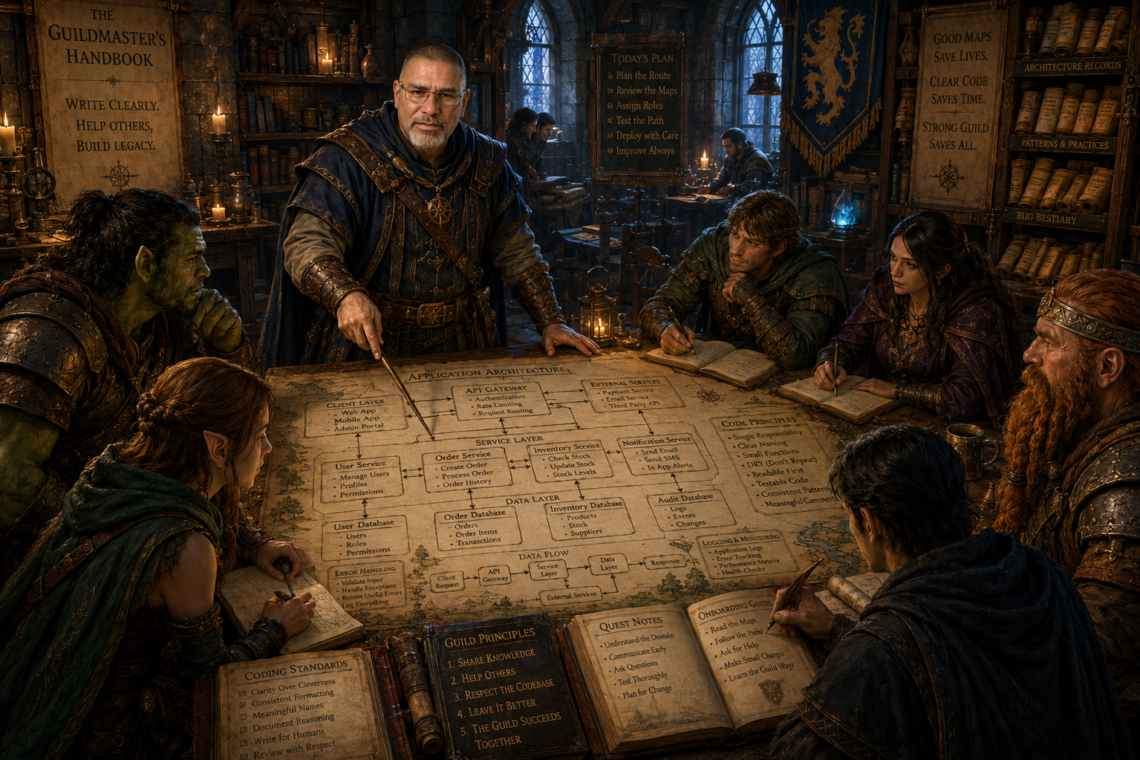
• Frank Jamison, portrayed as a seasoned guildmaster and veteran adventurer, stands at the center of a bustling fantasy guild hall, guiding a diverse group of adventurers around a massive strategy table. The table is covered with detailed architectural diagrams, software-inspired maps, flowcharts, and handwritten guild principles rendered as medieval cartography. Shelves of scrolls, books, and guild records line the walls, while lanterns and warm candlelight illuminate the collaborative scene. Adventurers of multiple races and classes study notes, discuss plans, and learn from Frank's guidance. The image symbolizes code readability, mentorship, onboarding, documentation, and teamwork through visual metaphors of maps, pathways, and shared knowledge within a thriving adventurer's guild.
    The Guildmaster’s Handbook

    Writing Code Others Can Read

    The guild hall is crowded with adventurers. Write clearly, or your allies become your next obstacle. Life Inside the Guild Hall One of the first misconceptions many developers carry into the profession is the belief that software development is primarily a solitary activity. Popular culture often reinforces this image. We imagine a lone programmer sitting in a dimly lit room, crafting brilliant solutions through sheer technical skill and determination. While moments of solitary work certainly exist, the reality is far different. Most software is built, maintained, reviewed, and expanded by teams. Success depends as much on communication as it does on technical ability. This week’s theme is Surviving the Guild…

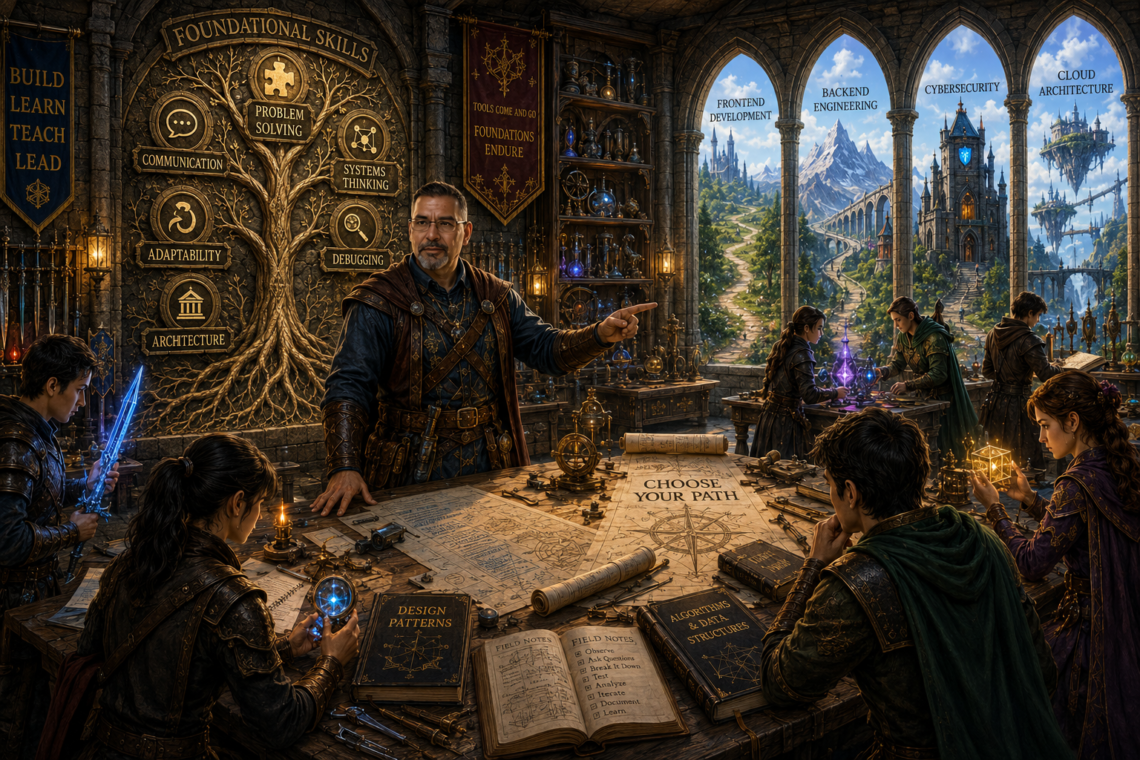
  • Frank Jamison, portrayed as a seasoned guildmaster and veteran engineer, stands in a grand fantasy training hall guiding young adventurers toward foundational skills rather than magical treasures. A towering stone skill tree labeled Communication, Problem Solving, Systems Thinking, Adaptability, Debugging, and Architecture dominates the wall behind him. Apprentices study maps, engineering blueprints, notebooks, drafting tools, and glowing artifacts around a massive wooden training table marked Choose Your Path. Through large arched windows, fantasy landscapes represent different technology career paths including Frontend Development, Backend Engineering, Cybersecurity, and Cloud Architecture. Warm torchlight and subtle blue magical illumination create a wise, instructional atmosphere emphasizing mentorship, learning, and long-term skill development.
    The Guildmaster’s Handbook

    Building Skills That Actually Matter

    The realm rewards more than talent. Learn the skills that survive beyond tutorials and trends. When new adventurers first enter a guild hall, they tend to focus on the same question. Which class should I choose? Some are drawn to warriors because they appear dependable and powerful. Others are fascinated by wizards because of the possibilities that magic provides. Rangers, rogues, clerics, and bards all offer their own attractions. New developers often approach technology in exactly the same way. They ask whether they should become frontend developers, backend engineers, cybersecurity specialists, cloud architects, or data professionals. While the question is understandable, I have learned over the years that it is…

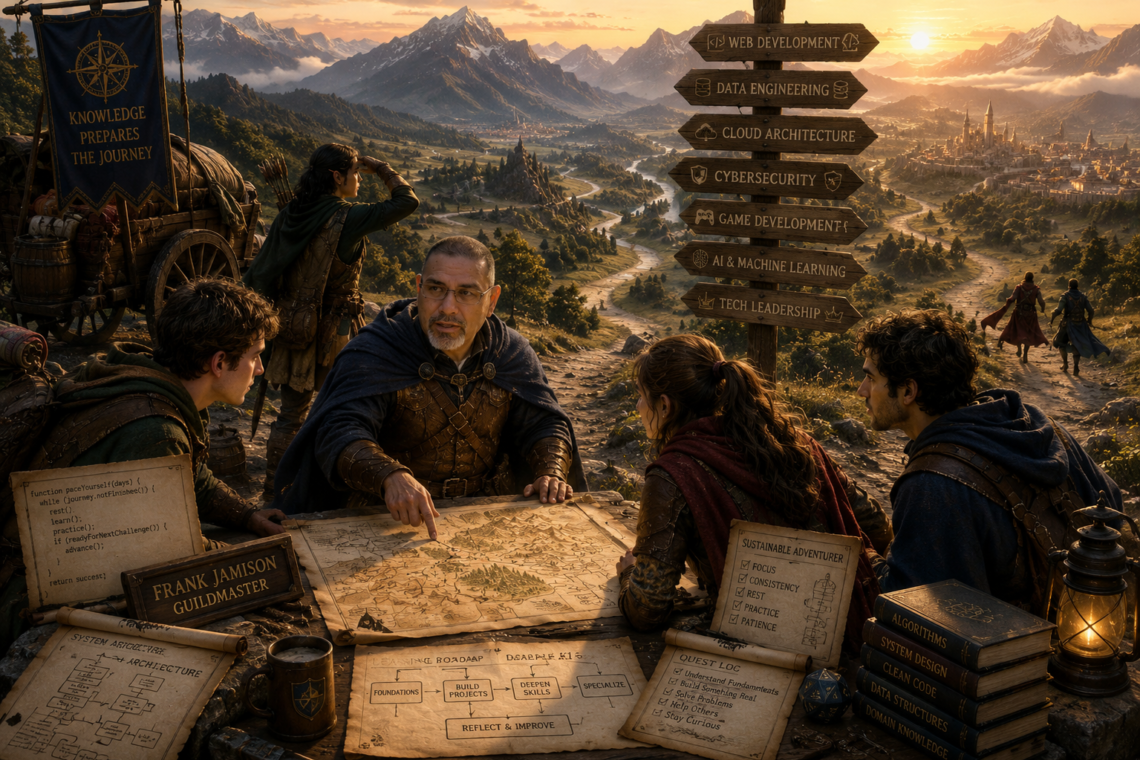
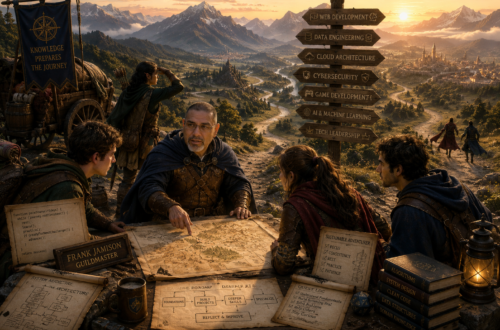
  • Frank Jamison, depicted as a seasoned guildmaster and mentor, leads a group of younger adventurers at sunrise while gathered around a large map beside a mountain crossroads. Wearing practical fantasy adventuring attire, he points toward multiple roads stretching through forests, valleys, mountains, and distant cities, symbolizing different technology career paths. Around the group are travel wagons, lanterns, books, engineering diagrams, code-filled scrolls, learning roadmaps, and quest logs that represent sustainable skill development. A towering signpost lists various specialties, including web development, cloud architecture, cybersecurity, and machine learning. The scene emphasizes mentorship, planning, endurance, and choosing a path wisely, with warm golden light illuminating the vast landscape and reinforcing the article's theme of learning without burning out.
    The Guildmaster’s Handbook

    Learning Without Burning Out

    No warrior survives every battle at full speed. Pace yourself, or exhaustion becomes the enemy. In our last gathering at the guild hall, I spoke about choosing a path. Every developer eventually faces a decision about where to invest time, energy, and attention. Some are drawn toward frontend development. Others find themselves fascinated by backend systems, cybersecurity, cloud infrastructure, data science, or countless other specialties. Choosing a path provides direction, but direction alone is not enough. An adventurer who charges down the correct road at an unsustainable pace may still fail to reach the destination. One of the most important lessons I have learned throughout my career is that success…

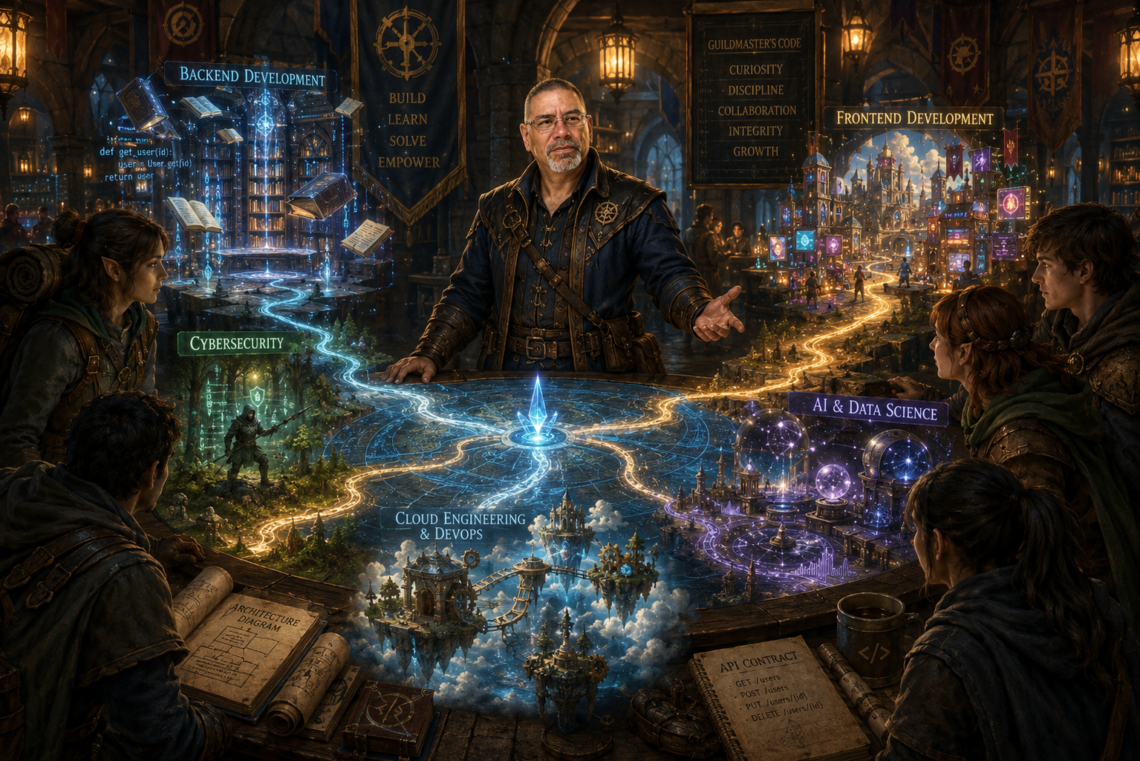
  • Frank Jamison, portrayed as a seasoned guildmaster and veteran engineer, stands at the center of a grand medieval guild hall, guiding a group of young adventurers around a glowing magical map table. Multiple illuminated pathways branch from a central crossroads toward fantasy realms representing technology career paths, including backend development, frontend development, cybersecurity, cloud engineering and DevOps, and AI and data science. Floating books, architectural diagrams, magical runes, code fragments, and enchanted cityscapes surround the table, while warm lantern light and blue magical energy create an atmosphere of mentorship, discovery, and professional growth. The scene blends Dungeons & Dragons-inspired fantasy with modern software engineering concepts, symbolizing the process of choosing a path in technology.
    The Guildmaster’s Handbook

    Picking Your Class in Tech

    Every adventurer begins with uncertainty. The path matters less than learning why you walk it. When people first enter the technology profession, they often ask a question that reminds me of every new player sitting down at a Dungeons and Dragons table for the first time. They want to know which class they should choose. Should they become a frontend developer, a backend developer, a cybersecurity analyst, a cloud engineer, a data scientist, or an artificial intelligence specialist? They worry that making the wrong decision will send them down a road that is difficult to escape. After many years in technology, I have learned that this concern is understandable, but…