Stack n' Scroll

Code, Campaigns, and Lessons from the Digital Realm

August 2026
S M T W T F S
 1
2345678
9101112131415
16171819202122
23242526272829
3031  
« Jul    

Meta

  • Register
  • Log in
  • Entries feed
  • Comments feed
  • WordPress.org
Frank Jamison Avatar
  • Stamp Evaluation – Scott #985 (Used, Hinged, No Original Gum – Single Stamp) 3¢ Carmine Rose – Grand Army of the Republic, 1949 (Commemorative Issue – Rotary Press Printing, Perf 11 x 10½, Unwatermarked) Design Overview: Scott #985 commemorates the final national encampment of the Grand Army of the Republic. The design features an elderly Civil War veteran in the foreground, a younger soldier behind him, and the GAR emblem at left above the denomination. “United States Postage” anchors the lower tablet, while the commemorative inscription spans the top. Printed in carmine rose, the engraving retains strong color, clear portrait detail, and good contrast. Grading Breakdown: The centering grade is Fine/Very Fine 78. Visually, with the unaided eye, the perforation holes are easily seen to be clear of the design, but one or two margins are narrow. The bottom margin is the most narrow and establishes the centering limit. The left margin is the least narrow, while the right margin is more narrow than the top. All margins remain clearly outside the design and satisfy the Fine/Very Fine standard. The stamp presents pleasing overall balance, with the lower margin as the primary visual limitation. Soundness Evaluation: The faults present are two shorter perforations approximately half normal length and four fuzzy or ragged perforations. These faults constitute Minor Fault soundness. Minor Fault soundness combined with Fine/Very Fine centering yields a preliminary grade of Very Good 58. The group of shortened and ragged perforations is the controlling condition issue, while the stamp otherwise retains a clean appearance. Perforations and Margins: The perforations are generally complete, but several teeth show the shortened, fuzzy, or ragged condition noted in the fault list. These irregularities slightly soften the otherwise clean outline of the stamp. The bottom margin is closest to the design, the left margin is widest, and the right margin is narrower than the top. The frame remains visibly clear of the perforation holes on all four sides. Cancellation Evaluation: No visible cancellation appears on the face of the stamp. The portraits, GAR emblem, denomination, top inscription, and lower tablet are fully visible without postal markings crossing the design. For a used stamp, this creates a clean front presentation, though the absence of a visible cancel is treated conservatively and does not automatically produce a grade increase. Collector’s Note: Scott #985 is a historically appealing commemorative for collectors of Civil War memory, veterans’ organizations, patriotic themes, and late 1940s United States issues. The paired veteran-and-soldier design gives the stamp strong symbolic impact. Eye Appeal Adjustment: After centering and soundness are determined, eye appeal is considered. The stamp retains fresh carmine rose color, a sharp engraved impression, and an unobstructed design. The perforation faults have already been accounted for in soundness, and there is no heavy cancellation to penalize. No additional adjustment is warranted, so the preliminary grade remains 58. Final Numerical Grade Calculation: The centering grade is Fine/Very Fine 78. Minor Fault soundness reduces the grade by 20 points, producing a preliminary grade of Very Good 58. No cancellation deduction or other eye appeal adjustment is applied. The final numerical grade is 58. Summary: This used Scott #985 shows Fine/Very Fine 78 centering, with the bottom margin most narrow, the left margin widest, and the right margin narrower than the top. Minor Fault soundness lowers the preliminary grade to Very Good 58. Clean color and an unobstructed face support the result without changing it. Final Grade: Very Good 58.
    The Full-Stack Campaign

    The First Map: How the Browser Shapes the World

    April 6, 2026 /

    Every adventure begins with understanding the terrain beneath your feet. Editor’s Note: This article is an expanded and revised edition of a piece originally published on RandomThoughtsInTraffic.com. For its StackNScroll release, the material has been substantially updated with deeper coverage of browser architecture, rendering behavior, document parsing, resource loading, and the relationship between structure, presentation, and interactivity. New sections have been added to explain the browser’s rendering pipeline, introduce foundational performance concepts, and establish the technical groundwork for future articles in The Full-Stack Campaign. As part of this week’s Foundations of the Realm theme, the goal is to help readers develop accurate mental models of how browsers transform source code…

    Read More
    Frank Jamison

    You May Also Like

    A monumental fantasy castle is shown in dramatic cutaway cross section, revealing its immense stone foundations extending deep into bedrock beneath the kingdom. Glowing golden architectural lines, magical construction diagrams, geometric overlays, and blueprint-style annotations trace the load-bearing arches, columns, bridges, stairways, and vaulted chambers that support the entire structure. Warm sunlight illuminates the thriving realm above while cool blue light radiates from the hidden foundations below, symbolizing that enduring strength comes from carefully designed structure. The detailed editorial illustration evokes a Dungeons & Dragons-inspired architectural masterpiece, visually representing the unseen framework that supports a successful software system.

    The Bones of the Realm: Writing Semantic HTML That Holds

    April 8, 2026
    A fantasy-inspired editorial illustration shows a developer wizard standing before a glowing magical orb labeled Source of Truth, symbolizing application state as the central authority in a web application. On the left, a dark stone chamber labeled DOM Manipulation is filled with tangled event listeners, sticky notes, and crisscrossing connections that represent tightly coupled code and hidden complexity. On the right, a bright architectural diagram labeled Separation of Concerns organizes business logic, application state, and presentation into distinct layers connected by a clear flow. An open spellbook in the foreground contrasts the problem of treating the DOM as memory with the solution of allowing the application to own its state. Books labeled HTML, CSS, and JavaScript, along with castles, mountains, and magical effects, reinforce the Dungeons & Dragons theme while illustrating the transition from direct DOM manipulation to maintainable frontend architecture.

    The Cost of Power: From DOM Manipulation to Better Design

    April 17, 2026
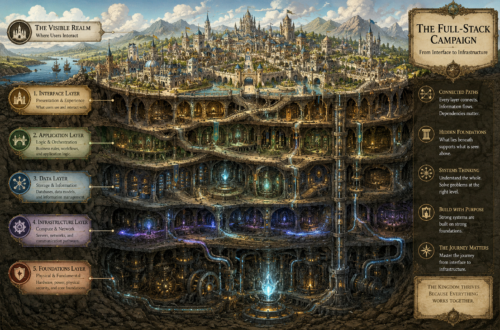
    Detailed fantasy cross-section illustration titled The Full-Stack Campaign: From Interface to Infrastructure. A sprawling medieval fantasy kingdom filled with castles, towers, bridges, marketplaces, and guild halls sits on the surface beneath a bright sky. The ground beneath the city is cut away to reveal multiple interconnected underground layers extending deep into the earth. Massive stone roads, elevators, tunnels, aqueducts, glowing magical conduits, and engineering works connect hidden chambers, archives, vaults, transit networks, and subterranean fortresses. The deepest levels contain enormous dwarven-style machinery, crystal power systems, and foundational infrastructure supporting the realm above. Informational panels label each layer of the kingdom, visually illustrating how visible systems depend upon increasingly complex hidden foundations. The image conveys themes of architecture, interconnected systems, dependencies, and the journey from user-facing experiences to the infrastructure that supports them.

    From Interface to Infrastructure

    April 4, 2026
  • The Architect's Grimoire (13)
  • The CSS Codex (13)
  • The Enchanted Workshop (9)
  • The Full-Stack Campaign (7)
  • The Guildmaster’s Handbook (13)

AI-Assisted Development Artificial Intelligence Backend Development Career Development Clean Code Code Quality CSS CSS Architecture CSS Best Practices CSS Fundamentals CSS Layout Design Systems Developer Education Developer Growth Developer Productivity Dungeons and Dragons Engineering Culture Engineering Judgment Engineering Leadership Fantasy Theme Front-End Development Frontend Development Full Stack Development Maintainable Code Maintainable CSS Mentorship Professional Development Professional Growth Refactoring Responsive Design Software Architecture Software Craftsmanship Software Design Software Development Software Engineering StackNScroll System Design Technical Debt Technical Leadership The Architect's Grimoire The CSS Codex The Enchanted Workshop The Full-Stack Campaign The Guildmaster's Handbook Web Development

Stack N' Scroll - 2026 ©