-
When Two Kings Claim the Throne: Consistency in Distributed Systems
Truth becomes complicated when the kingdom keeps more than one copy of it. When One Truth Becomes Many: Distributed Systems The Kingdom Keeps Copies for a Reason: Distributed Data and Replication In a small application, truth appears simple. A user changes an email address, the application saves it, and the next request retrieves the same value. One database, one authoritative record, and usually one short path between the person making the change and the system storing it. Distributed systems complicate that arrangement. Data may be copied across regions, databases, caches, queues, search indexes, and services. Replication improves availability and performance, but it also creates a difficult question: when several systems…
-
Roads Through the Sky: Connecting Cloud-Native Services
A distributed kingdom survives only when its distant cities know how to speak. A single castle can rely on hallways. The kitchen knows where the pantry is, guards can walk directly to the armory, and a steward who needs an answer can cross the courtyard and ask for it. Once the kingdom spreads across distant cities, those assumptions disappear. The treasury may live in one region, the guild registry in another, and the market serving the public somewhere else entirely. Each city can function perfectly on its own and still leave the kingdom paralyzed if the roads between them are unreliable or poorly governed. Cloud-native systems inherit the same problem.…
-
Renting the Wizard’s Tower: Understanding Cloud Infrastructure
Owning every stone is not the same as controlling the kingdom. In the previous chapter of The Kingdom in the Clouds, Kubernetes provided a way to coordinate workloads across multiple machines. Pods could be replaced, deployments could maintain the desired state, and services could provide changing workloads with stable ways to communicate. That solved an important orchestration problem, but it left a deeper question unanswered: where do those machines come from, who maintains them, and how much responsibility should belong to the team running the application? Every container eventually consumes real processor time, memory, storage, and network capacity somewhere. Cloud infrastructure begins with the recognition that those resources have not…
-
The Keeper of a Thousand Castles: Understanding Kubernetes
When the kingdom grows beyond a few castles, someone must decide where every banner flies. A single container is easy to understand. You package an application, start it, expose a port, and watch it run. Add a database, cache, and supporting service, and Docker Compose can organize the small caravan well enough for development and modest deployments. The trouble begins when that caravan becomes a kingdom. Once dozens or hundreds of containers must remain available across multiple machines, the difficult question is no longer how to start them. The difficult question becomes who keeps track of everything after you stop watching. Imagine a kingdom dotted with castles. Each needs guards,…
-
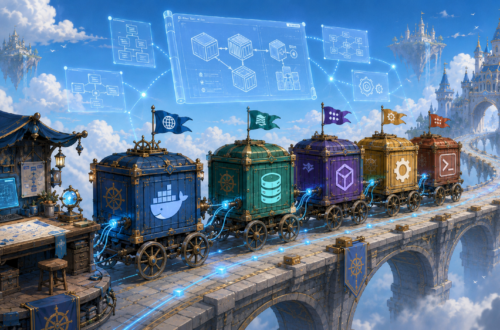
The Caravan of Services: Composing Containerized Applications
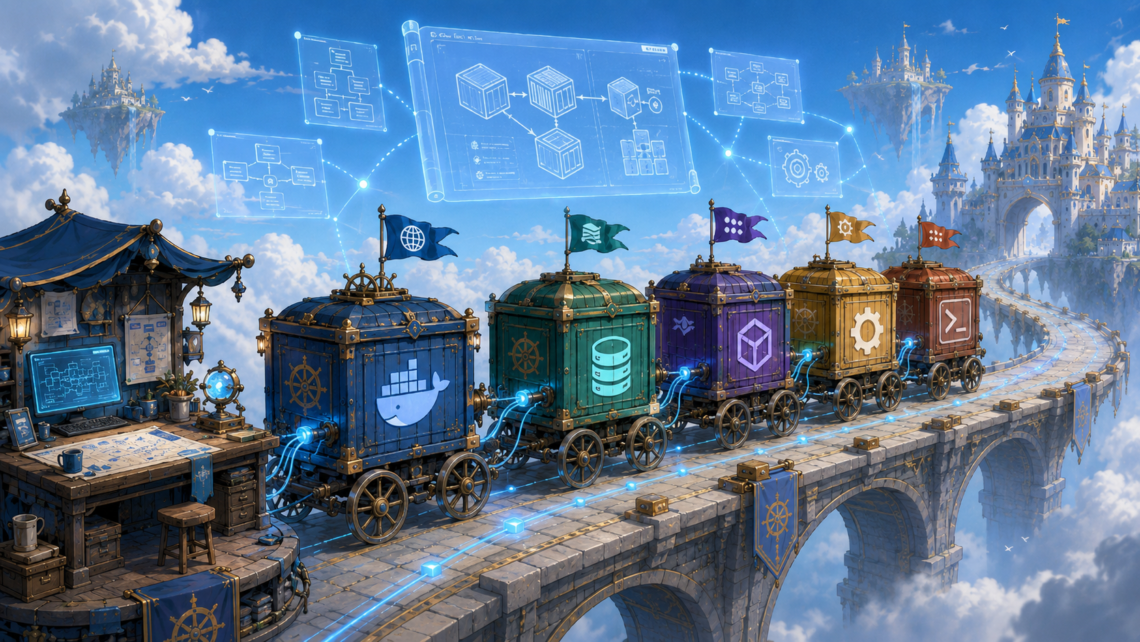
One wagon may travel alone, but a kingdom moves as a caravan. Beyond the Castle Gate: From Containers to Applications Packing a workshop into a container solves an important problem, but it does not solve the entire journey. In the previous chapter of The Kingdom in the Clouds, we explored how containers package an application together with the runtime, libraries, and dependencies it needs to operate consistently. That gives engineers a portable unit that can travel from a development machine to a test environment and eventually into production with far fewer surprises. Yet most modern applications are not single workshops sealed inside single wagons. They are collections of services, databases,…
-
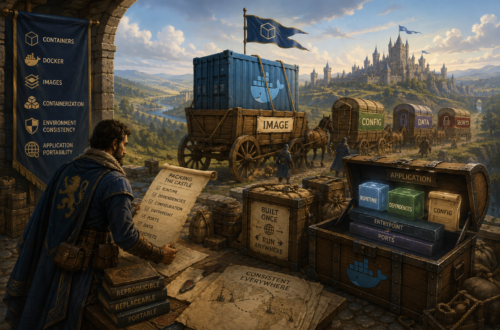
Packing the Castle: Understanding Containers
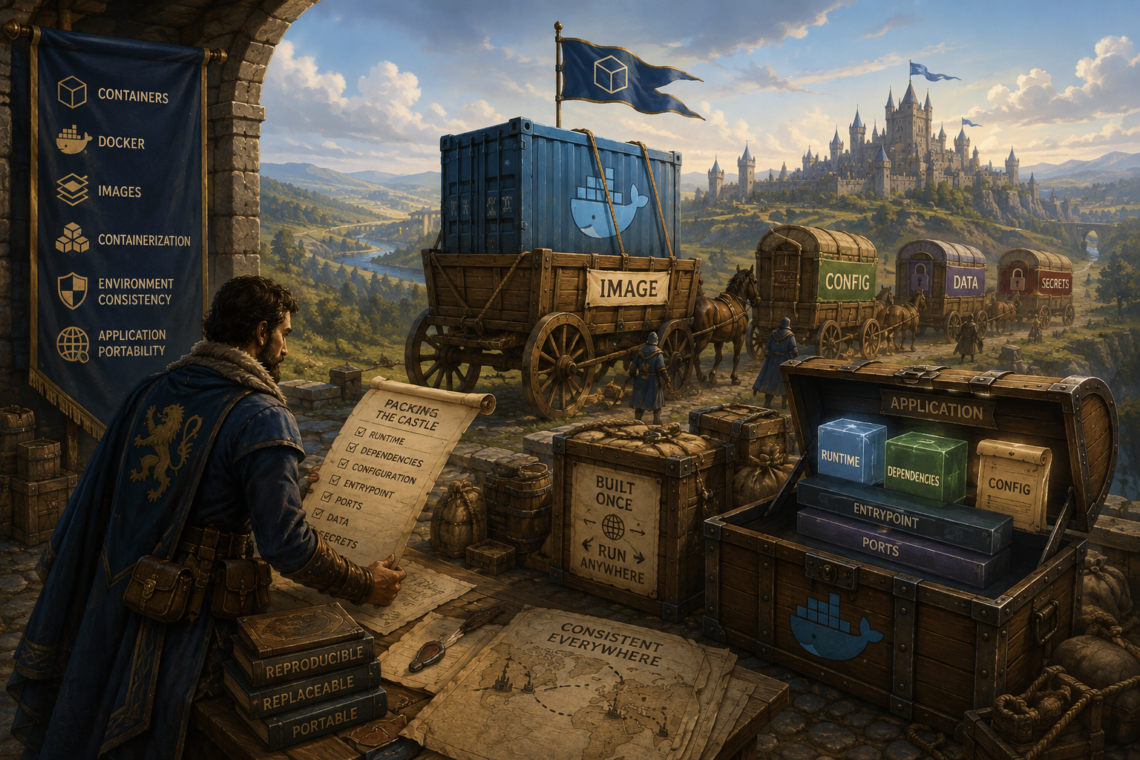
A well-packed workshop should work the same no matter where the road carries it. There is a particular kind of software failure that becomes almost funny after you have encountered it enough times. An application works perfectly on one developer’s machine, refuses to cooperate on another, behaves differently in testing, and then develops an entirely new personality after deployment. The code is the same, the database is supposedly the same, and everyone involved is reasonably certain that the necessary dependencies were installed. Yet somewhere between one machine and another, the application crossed an invisible border and discovered that the laws of physics had changed. For years, software teams fought these…
-
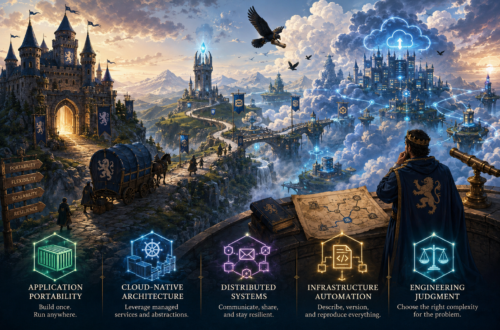
The Kingdom in the Clouds: When Software Leaves the Castle
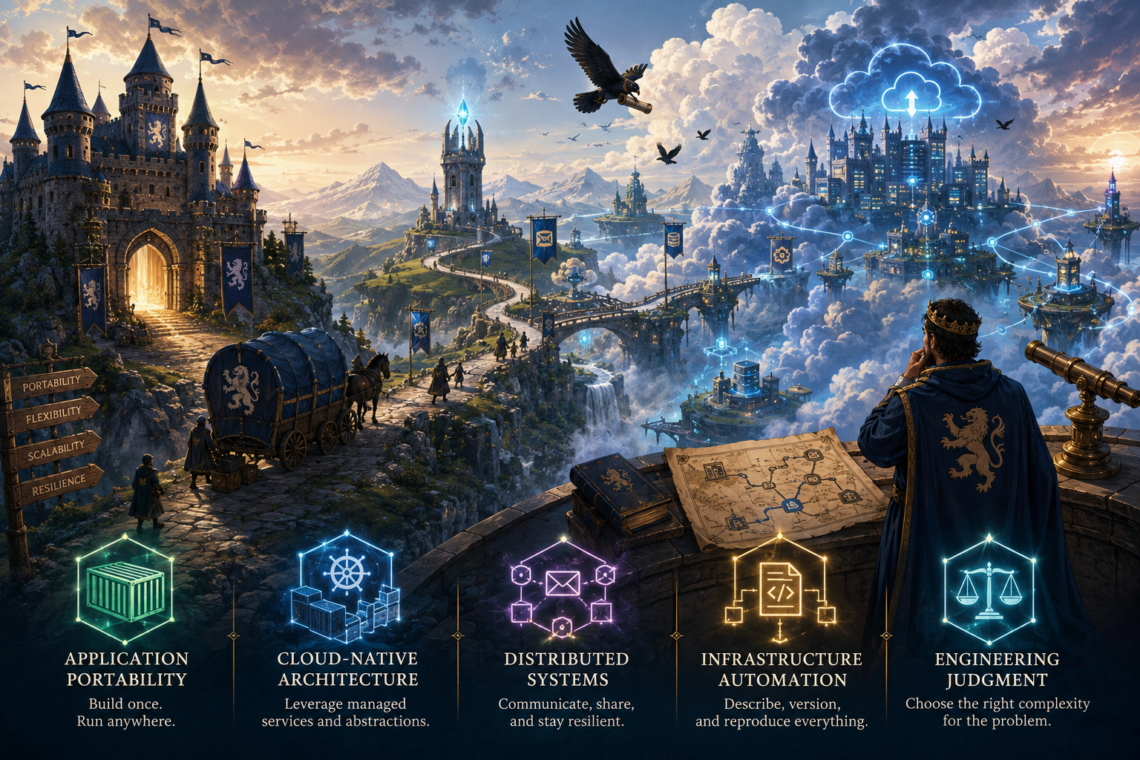
The strongest kingdoms are not bound to a single castle, but built to endure wherever their people must go. For much of software history, we built applications as though we were building castles. The walls gave us boundaries. We knew where the application lived, where its data lived, and which machines carried the work. Even complicated systems offered a comforting sense of geography because their important pieces occupied places engineers could identify and understand. When something failed, there was usually a server, process, database, or network connection somewhere that could be examined. Modern software has been steadily dismantling that certainty. Applications move between environments, workloads appear and disappear, and infrastructure…
-
The Workshop of Tomorrow: The Future of AI-Assisted Software Engineering
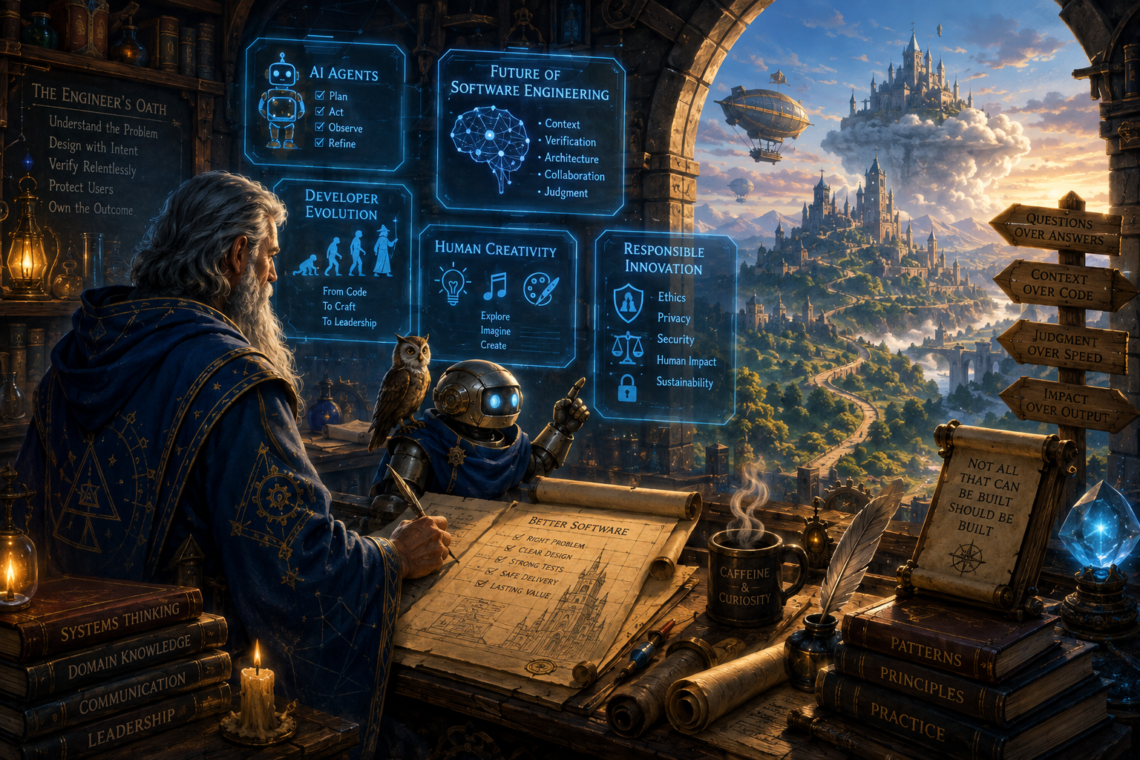
Every generation of wizards inherits greater magic and greater responsibility. There was a time when the most valuable object in a wizard’s workshop was the spellbook. It contained knowledge that had taken generations to discover and preserve, and a young wizard might spend years learning its incantations before being trusted to use them. Then imagine placing an enchanted tome on the workbench that could produce a new spell on demand, explain unfamiliar enchantments, repair damaged runes, and occasionally invent an incantation that sounded perfectly legitimate but summoned absolutely nothing. The workshop would become more productive almost overnight, but it would not become simpler. Software engineering has entered that workshop. AI-assisted…