Why Castles Need Architects
Even the finest builders need someone who can see beyond the next wall.
Foundations of the Kingdom
Maintaining software taught me lessons that writing software never could. Early in my career, I assumed difficult applications were usually the result of poor programming. Whenever a simple change required hours of investigation, I expected to uncover careless decisions, rushed deadlines, or code that had simply been neglected for too long. The more systems I inherited, however, the less convincing that explanation became. Different companies, different teams, and different programming languages produced remarkably similar maintenance problems. As we begin Foundations of the Kingdom, one lesson rises above all the others: every enduring kingdom rests upon choices few people ever see.
At first, I blamed the code. I assumed someone had written poor abstractions, ignored established practices, or simply accepted too many shortcuts under pressure. The more applications I maintained, however, the more I noticed the same pattern repeating itself. Systems built by talented engineers often became just as difficult to extend as systems written by inexperienced teams. Eventually, I realized I had been asking the wrong question. The issue was rarely the quality of the individual code. It was the structure connecting all of it together.
For a long time, I believed software architecture belonged to someone else. Architecture seemed reserved for senior engineers gathered around whiteboards discussing systems that had grown far beyond anything I had worked on. My responsibility, I thought, was to implement features correctly and let someone else worry about the bigger picture. Like many developers early in their careers, I believed architecture became important only after software reached a certain size. Experience gradually dismantled that assumption. Every dependency I introduced, every shortcut I accepted, every responsibility I assigned, and every boundary I ignored influenced the application’s future. Whether I recognized it or not, I was making architectural decisions every day.
That realization did not come from reading a book or attending a conference session. It came from maintaining applications that had already enjoyed years of success. The original developers were talented engineers who solved genuine business problems under real deadlines. Most of their code still worked exactly as intended. The challenge appeared whenever the business evolved. Features that seemed straightforward required touching dozens of files because responsibilities had gradually spread throughout the application. Every modification felt like tugging on a thread woven through the entire codebase.
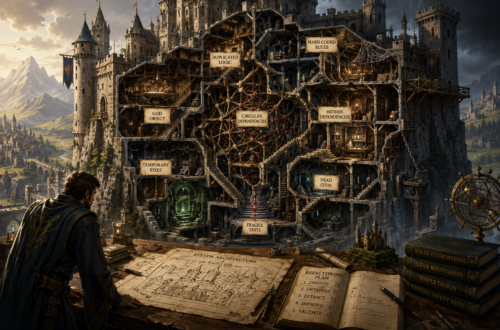
I remember opening one particular project and feeling unusually cautious before making what should have been a routine change. A small business rule needed updating, yet every attempt to trace its implementation revealed another dependency elsewhere. One service called another, which depended on utility classes that also updated reporting, triggered notifications, and shared validation logic with completely unrelated features. Nothing was obviously wrong. In fact, every individual decision made perfect sense when viewed by itself. Collectively, however, those decisions had created a system where changing one requirement felt less like editing software and more like pulling stones from the base of a castle wall, never quite knowing what else might shift before the work was finished.
Nobody deliberately created that codebase. Every developer solved the problem immediately in front of them. A report needed another query, so they added one. Marketing wanted automated emails, so notification logic found a convenient home inside an existing service. Another feature required access to the same data, so business rules were copied rather than extracted. None of those decisions appeared dangerous in isolation. Several years later, changing almost anything required modifying code scattered throughout the application because every solution had quietly become another dependency.
That experience permanently changed the questions I asked myself while writing software. Instead of asking whether my solution worked, I began asking what kind of future my solution was creating. Would another developer understand where new functionality belonged? Would changing one requirement unexpectedly affect unrelated parts of the application? Would I still understand my own reasoning after returning to the project six months later? Those questions rarely added much time to my work, yet they dramatically reduced the amount of time I later spent untangling decisions I wished I had made differently.
The Kingdom Without an Architect
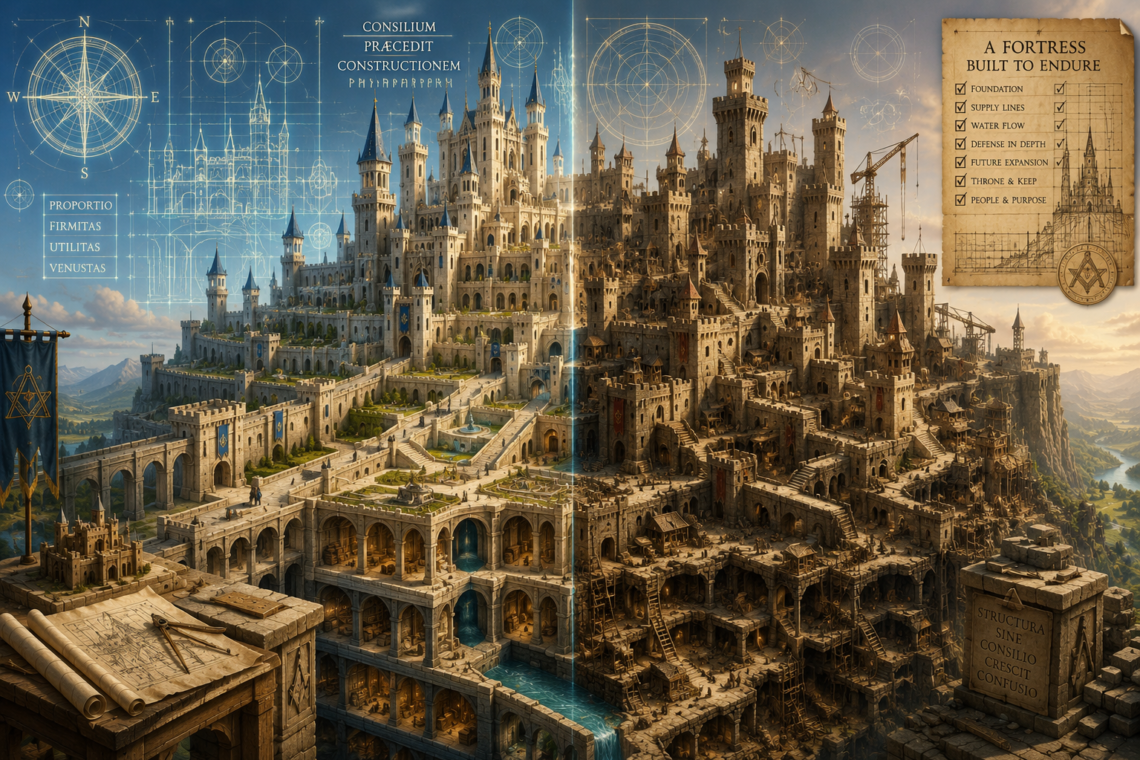
Imagine asking one hundred of the finest builders in the realm to construct a castle without appointing a royal architect. The stonemasons understand stone. The carpenters understand timber. The blacksmiths forge magnificent gates. Every guild excels within its own craft, yet nobody is responsible for asking how those accomplishments fit together. Should the barracks stand beside the armory? Can supplies reach the inner keep during a siege? Is there room for the city to expand fifty years from now? Every guild assumes someone else has already answered those questions.
The finished castle would almost certainly be magnificent. Visitors would admire soaring towers, elegant halls, and beautifully carved gates. The hidden weaknesses would not reveal themselves immediately because every individual structure had been built by skilled craftsmen. Years later, however, the kingdom would begin paying the price for decisions that were never coordinated. Expanding the marketplace blocks military traffic. Reinforcing one tower weakens another. New defensive walls require demolishing buildings that never should have occupied that space in the first place. Each decision made perfect sense on the day it was made. Together, they gradually transformed an extraordinary collection of buildings into a kingdom that had become increasingly difficult to govern.
Applications rarely become difficult because a single developer writes a terrible function. They become difficult because dozens of capable developers make hundreds of reasonable decisions over months and years, each focused on solving the problem immediately in front of them. Without someone regularly stepping back to consider the system as a whole, those individually sensible decisions begin interacting in unexpected ways. Complexity emerges naturally, not because the developers lacked skill, but because nobody was responsible for protecting the shape of the kingdom they were collectively building.
That is why castles need architects. Builders focus on placing the next stone correctly because it matters. Architects spend equal time considering the hundred stones that have not yet been placed. They understand that every wall influences the rooms beside it, every hallway changes how people move throughout the kingdom, and every foundation limits what future generations can build above it. Good software requires both perspectives. Without builders, nothing is ever finished. Without architects, today’s success gradually becomes tomorrow’s obstacle.
The First Survey of the Kingdom
Many developers believe architecture begins when someone opens a diagramming application and starts drawing boxes connected by arrows. Those diagrams certainly communicate architectural decisions, but they are not architecture itself. They simply record conclusions that have already been reached. Long before anyone sketches a diagram, an experienced architect has already begun asking a different set of questions. Those questions become the true foundation upon which every successful system is built.
Instead of asking what code should be written, architects begin by asking what responsibilities should exist. Which parts of the application belong together? Which pieces should remain independent? Where should business rules live? What parts of the system are most likely to change during the next year? Those questions rarely appear on sprint boards because they do not produce immediately visible features. They do, however, determine whether the next fifty features become easier or harder to build.
Over time, I developed a habit that changed the way I evaluated every application I worked on. Whenever a seemingly simple requirement forced me into several unrelated parts of the codebase, I stopped treating it as an inconvenience and started treating it as architectural feedback. The software was trying to tell me something. Responsibilities had become blurred. Dependencies had become tighter than they needed to be. The application’s underlying structure had been asking for attention long before users ever noticed a problem.
That shift in thinking changed how I measured success as a developer. Delivering features remained important because software exists to solve real problems for real people. At the same time, I began holding my work to a second standard. Could another engineer confidently extend what I had built without first untangling my decisions? Good architecture rarely announces itself through clever abstractions or impressive diagrams. More often, it reveals itself months later when substantial new features feel surprisingly straightforward because someone invested in the foundation before anyone knew exactly what would eventually stand upon it.
Blueprints Before Bricks
Imagine that the king announces a new fortress must be completed before winter arrives. The urgency is genuine. Trade routes need protection, nearby villages require shelter, and scouts report growing activity along the northern border. An inexperienced builder hears that urgency and immediately begins laying stone because every hour spent planning appears to delay visible progress. Walls begin to rise almost immediately, towers start to take shape, and everyone celebrates how quickly construction is moving.
An experienced royal architect reaches a very different conclusion. Urgency does not eliminate the need for thoughtful planning. It makes careful planning even more important. Before assigning workers to individual tasks, the architect studies the terrain, determines how supplies will enter the fortress, considers where future expansions may eventually stand, and ensures the kingdom is building more than a collection of impressive walls. Those conversations produce little visible progress in the first week, yet they determine whether the castle will continue to serve the kingdom decades after the last stone has been laid.
Software projects reward that same discipline. It is tempting to begin writing code as soon as the requirements appear stable enough to support implementation. After all, code is visible progress. Planning often feels like delaying the real work. Experience has taught me the opposite lesson. A few thoughtful questions before implementation usually eliminate hours of unnecessary redesign later. Time spent understanding the problem is almost never wasted because good architecture begins with understanding, not construction.
One technique that has served me well is describing a feature without mentioning technology. If I cannot explain the responsibility in plain language, I probably do not understand the problem well enough to design a solution. Thinking in terms of frameworks, databases, or programming languages too early often pushes me toward implementation before I fully understand the business need. Architecture begins with responsibilities. Technology exists to support those responsibilities, not define them.
Suppose a product owner asks for the ability to retrieve customer information. Many developers immediately begin thinking about controllers, API endpoints, database queries, and user interface components. Those are all necessary pieces of the solution, but they are not the responsibility itself. The real responsibility is much simpler. The application needs a reliable way to obtain customer information. Once that responsibility is clearly defined, implementation choices become much easier to evaluate because they support an already understood purpose rather than shape one.
Consider this example.
</> JavaScript

async function loadCustomer(id) {
    const response = await fetch(`/api/customers/${id}`);
    const customer = await response.json();

    document.querySelector("#name").textContent = customer.name;
    document.querySelector("#email").textContent = customer.email;

    analytics.track("customer-viewed", customer.id);
    logger.info("Customer loaded");

    return customer;
}
Early in my career, I would have considered this perfectly acceptable. The feature works exactly as requested. Customer data is retrieved, displayed on the page, logged for diagnostics, and recorded for analytics. If the ticket simply asked for customer information to appear on the screen, I would have happily marked the work complete.
Experience eventually taught me to read this function differently. It retrieves data. It updates the user interface. It records analytics. It writes diagnostic logs. It participates in the application workflow. None of those responsibilities is inherently wrong, but they are unlikely to change together over time. When unrelated responsibilities occupy the same function, future developers inherit decisions they did not make and relationships they may not immediately understand.
A small refactoring dramatically changes the design’s long-term flexibility.
</> JavaScript

async function loadCustomer(id) {
    return customerRepository.findById(id);
}

const customer = await loadCustomer(id);

customerView.render(customer);
analytics.recordCustomerViewed(customer.id);
logger.info("Customer loaded");
Notice what changed. We did not make the feature more capable. We made future changes less expensive. Retrieving customer information now has a single, well-defined responsibility. Presentation, analytics, and logging remain important, but they are no longer intertwined with data retrieval. If any one of those concerns changes later, the others remain largely unaffected.
The objective was never to write less code. It was to organize the code so that future developers immediately understand where new behavior belongs. That is one of the quiet advantages of thoughtful architecture. Instead of forcing every developer to rediscover the application’s structure, the structure begins to guide their decisions. It becomes easier to answer not only how to implement a feature, but where that feature naturally belongs.
The Throne Room Is Not the Kingdom
One lesson I wish I had learned much earlier in my career is that users rarely experience software the way developers do. Users see features, workflows, and results. Developers see responsibilities, dependencies, abstractions, and boundaries. Both perspectives matter because software exists to solve problems for people, not to showcase elegant engineering. At the same time, every polished feature rests on architectural decisions that determine whether the application will continue to serve its users successfully years from now.
That is why experienced engineers spend time discussing subjects that often appear invisible to everyone else. They debate ownership, data flow, coupling, cohesion, service boundaries, and communication between components. Those conversations may seem disconnected from feature development because they do not immediately produce something a customer can click or interact with. In reality, they protect the team’s ability to continue delivering features without having to repeatedly rebuild yesterday’s work. Good architecture is not separate from development. It is one of the reasons development continues to move efficiently as an application grows.
Over the years, I have noticed another characteristic shared by the best architects I have worked alongside. They rarely claimed to know exactly what the future would require. Instead, they assumed the future would surprise them. Businesses change direction. Customers discover workflows nobody anticipated. Regulations evolve. New technologies appear while older ones quietly disappear. Rather than attempting to predict every possibility, experienced architects build systems that adapt without forcing developers to redesign the application whenever the business changes its mind.
That realization changed how I evaluated my own designs. Earlier in my career, I often wondered whether I had anticipated future requirements well enough. Eventually, I realized I was asking the wrong question. Good architecture is not measured by how accurately it predicts the future. It is measured by how gracefully it responds when those predictions prove incomplete. The goal is not to eliminate change. The goal is to make change feel like a normal part of software development instead of a crisis that threatens the stability of the entire application.
Perhaps that is why architecture is often described as an exercise in judgment rather than a collection of rules. Programming languages evolve. Frameworks rise and fall in popularity. Design patterns are rediscovered, renamed, and occasionally misunderstood by successive generations of developers. Sound engineering judgment outlives every technology trend because it focuses on organizing software around responsibilities rather than tools. The technologies we use will change many times during our careers. The principles behind thoughtful architecture will continue serving us regardless of what comes next.
Earning the Architect’s Compass
Many developers imagine there is a single moment when someone becomes an architect. Perhaps it arrives with a promotion, a new job title, or responsibility for designing a larger system. My experience has been much quieter than that. The transition begins when a developer starts looking beyond the feature directly in front of them. Implementation remains important, but it is no longer the only concern. The long-term health of the application is considered in every technical decision.
That change in perspective does not require permission from a manager or decades of experience. It can begin with the very next feature you build. Every time you pause to consider where a responsibility belongs, question whether two components should really know about one another, or ask how the next engineer will extend your solution, you are practicing architecture. Those decisions may seem insignificant when viewed individually, but software architecture is rarely built through dramatic moments. It emerges through hundreds of thoughtful choices made consistently over time.
Another lesson took me longer to appreciate than I would like to admit. Good architects are willing to change their minds. Every design reflects our best understanding of a problem at a particular moment. As that understanding improves, the architecture should improve with it. Refactoring is not an admission that the original design failed. More often, it is evidence that the team has learned something valuable about the problem they are solving. The strongest kingdoms were not those that never changed. They were those designed to evolve without sacrificing their stability.
Experience is not measured simply by the number of years we have written software. It is measured by the number of times we have watched yesterday’s decisions influence today’s work and allowed those observations to improve tomorrow’s decisions. The architects I have admired most were never the people who could recite the greatest number of design patterns from memory. They were the ones who consistently recognized the difference between solving today’s problem and unintentionally creating tomorrow’s problem.
Closing the Grimoire
When visitors admire a magnificent castle, they notice soaring towers, towering walls, elegant gates, and colorful banners flying above the battlements. Very few stop to admire the foundation beneath the stone, the placement of the corridors, or the countless design decisions that allowed the kingdom to expand for generations without losing its strength. Those choices remain largely invisible because they enable everything else to succeed.
Software architecture serves the same purpose. Developers naturally enjoy building features because features are visible, measurable, and immediately valuable. Architecture works beneath the surface, ensuring the next feature, and the one after that, can be built without constantly undoing the work that came before. Every responsibility we clarify, every dependency we simplify, and every boundary we establish becomes another stone supporting the next engineer who may one day inherit our work.
If there is one lesson I hope you carry away from this first chapter of The Architect’s Grimoire, it is that architecture is not something we add after writing the code. It begins with the very first decision we make about how that code should be organized, and it continues every time we choose between the solution that merely satisfies today’s requirement and the solution that also protects tomorrow’s opportunity. Every enduring application is shaped by thousands of such decisions, most of which go unnoticed by the people who ultimately benefit from them.
We will spend this first week laying the Foundations of the Kingdom, but foundations alone do not build a lasting fortress. Every architect eventually faces a question that has challenged builders for centuries. Should we design only for the quest standing before us, or should we prepare for an empire that may never come? Build too narrowly, and future growth becomes unnecessarily expensive. Build too broadly, and today’s progress slows beneath complexity that serves no immediate purpose.
That balance sits at the heart of architectural judgment, and it is where we will continue our journey on Wednesday in Building for Today’s Quest or Tomorrow’s Empire? Together, we will explore one of the most difficult decisions every software architect must make: understanding not only what is worth building, but also when to build it.


You May Also Like

The Royal Treasury: Protecting the Kingdom’s Data

The Curse of Premature Fortification