Stack n' Scroll

Code, Campaigns, and Lessons from the Digital Realm

October 2026
S M T W T F S
 123
45678910
11121314151617
18192021222324
25262728293031
« Sep    

Meta

  • Register
  • Log in
  • Entries feed
  • Comments feed
  • WordPress.org
Frank Jamison Avatar
  • A sweeping high-angle fantasy landscape depicts a thriving medieval kingdom interconnected by an extensive network of beautifully engineered stone roads and towering arched bridges. Magnificent walled cities, castles, villages, ports, and mountain fortresses are linked across rivers, cliffs, forests, fertile farmland, and snow-capped peaks, emphasizing the infrastructure that unites the realm. Merchant caravans, mounted couriers, travelers, and supply wagons move peacefully along the highways beneath warm golden morning light, illustrating dependable communication, cooperation, and thoughtful planning. The image symbolizes well-designed software architecture, with the roads representing trusted APIs that seamlessly connect independent systems into a unified, flourishing kingdom.
    The Architect's Grimoire

    The Roads Between Cities: Building APIs Worth Trusting

    July 6, 2026 /

    Kingdoms prosper because their roads are trusted as much as their walls. A castle can stand for centuries and still preside over a dying realm. Towering walls may discourage invaders, magnificent keeps may inspire admiration, and disciplined soldiers may protect the capital, but none of those accomplishments guarantee prosperity. A thriving civilization depends upon something far less glamorous. Merchants must reach distant markets, royal couriers must carry news without delay, craftsmen must exchange ideas across provinces, and neighboring cities must cooperate toward common goals. Long before history remembers the greatness of a realm, it first remembers whether its roads could be depended upon. Software architecture follows the same principle. Well-designed…

    Read More
    Frank Jamison

    You May Also Like

    A fantasy-inspired digital illustration depicts a royal architect standing over maps and plans as a massive stone castle burns under a night sky filled with flaming projectiles. Although sections of the fortress are engulfed in flames, smaller fortified districts below remain connected by glowing blue pathways, symbolizing resilient system architecture and fault isolation. Floating holographic icons represent High Availability, Backups, Disaster Recovery, Fault Tolerance, and Incident Response, visually linking medieval defenses with modern software engineering concepts. Scrolls and architectural plans in the foreground reinforce themes of preparation, recovery, and thoughtful design, while the dramatic contrast between destruction and continuity emphasizes that resilient systems are designed to withstand failure rather than prevent it entirely.

    When the Kingdom Burns: Designing for Failure Before Disaster Strikes

    July 17, 2026
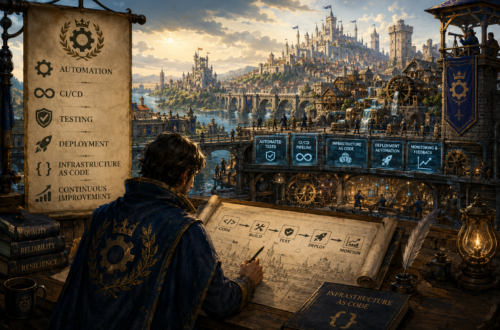
    A wise wizard studies a glowing crystal orb overlooking a vast fantasy kingdom where medieval architecture merges with modern software engineering. Across a towering stone aqueduct, six banners illustrate a continuous delivery pipeline labeled Automation, CI/CD, Testing, Deployment, Infrastructure as Code, and Continuous Improvement, with engineers working at illuminated stations beneath each stage. A detailed map on the wizard's table mirrors the same workflow using symbols and pathways, while holographic diagrams and glowing blue interfaces blend seamlessly into the medieval setting. The composition symbolizes mature software engineering practices transforming disciplined processes into an automated, self-improving kingdom, with warm golden light contrasting against cool blue technological elements. The article title does not appear in the image.

    Seeing Through the Crystal Ball: Observability Beyond Monitoring

    July 20, 2026
    A fantasy-inspired illustration depicts a master engineer overlooking a thriving medieval kingdom powered by invisible systems rather than heroic effort. In the foreground, a cloaked architect studies a blueprint illustrating a software delivery pipeline from code to build, test, deployment, and monitoring. Below, workshops, waterwheels, bridges, and aqueducts symbolize automated infrastructure supporting the bustling city above. Watchtowers overlook the realm while illuminated engineering panels represent automated testing, CI/CD pipelines, infrastructure as code, deployment automation, and monitoring. The scene conveys how automation, continuous improvement, and dependable engineering systems quietly enable a prosperous kingdom without drawing attention to themselves.

    The Automated Kingdom: When Excellence Becomes Routine

    July 22, 2026
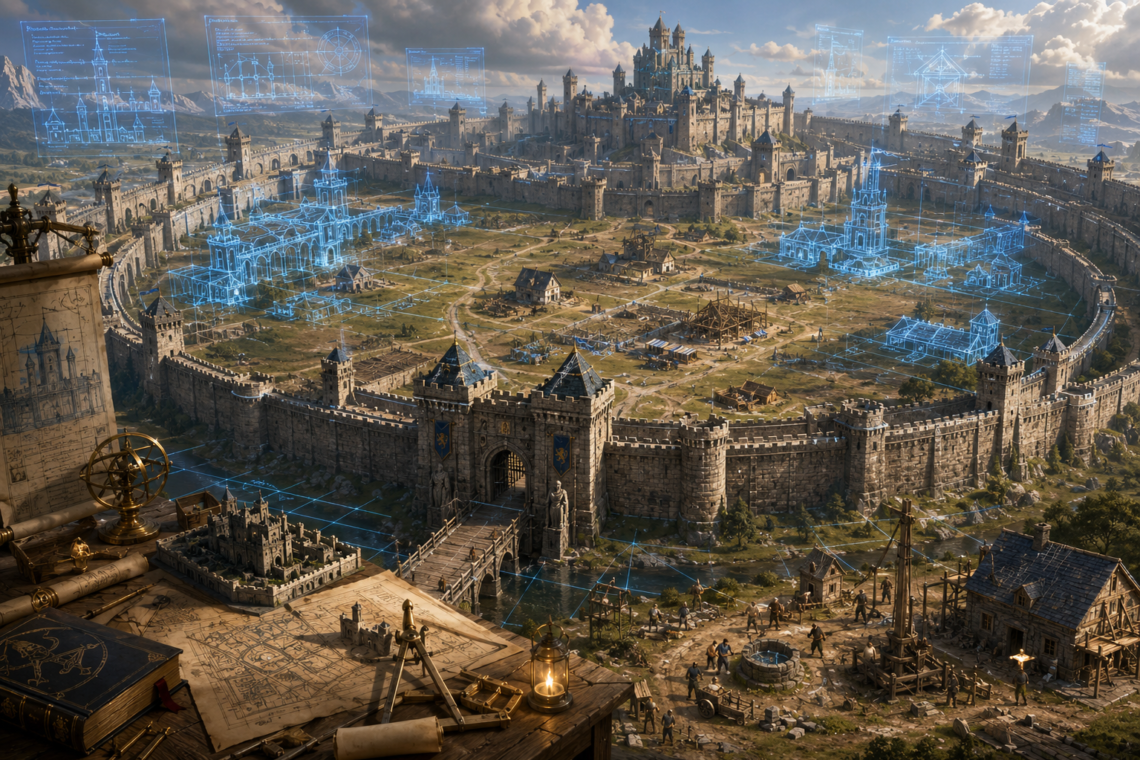
  • A vast medieval fantasy kingdom is enclosed within enormous concentric stone walls, towering gatehouses, fortified keeps, and defensive towers that dominate the landscape. Despite the immense fortifications, the protected interior remains largely undeveloped, with only a few cottages, a small farmhouse, scattered construction sites, unfinished roads, and a partially built marketplace spread across open fields. Glowing blue magical architectural projections overlay the empty city, revealing ambitious plans for future districts, guild halls, towers, canals, and public buildings that have yet to be constructed. In the foreground, drafting tables, blueprints, surveying instruments, and engineering tools reinforce the theme of excessive planning, while a small group of builders focuses on practical structures such as a well and simple homes. The painterly Dungeons & Dragons-inspired scene symbolizes the software engineering concept of premature overengineering by contrasting overwhelming defensive infrastructure with a kingdom that has barely begun to grow.
    The Architect's Grimoire

    The Curse of Premature Fortification

    July 3, 2026 /

    Not every empty field needs a fortress. Software rarely becomes difficult to maintain because developers lacked technical ability. More often, intelligent engineers create long-term maintenance problems by solving challenges that have not yet appeared. A project begins with a handful of straightforward requirements, but its structure quickly expands to accommodate hypothetical integrations, future scalability, interchangeable components, and extension points that may never become necessary. Before long, the codebase grows steadily larger while the problem it exists to solve remains remarkably small. Long before the application reaches maturity, supporting the design requires nearly as much effort as advancing the product itself. Good design prepares software to evolve as knowledge grows. Premature…

    Read More
    Frank Jamison

    You May Also Like

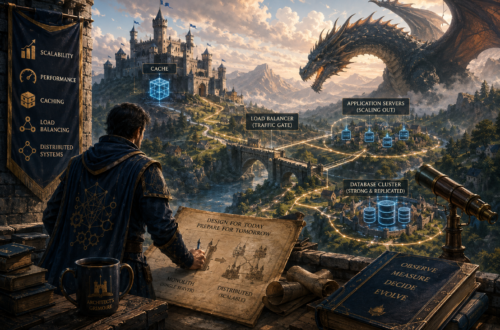
    A sprawling medieval fantasy kingdom stretches across a lush valley, with a fortified castle serving as the central hub of an expansive network of roads, bridges, and satellite settlements that symbolize a scalable software architecture. A massive dragon circles above the kingdom, representing the challenges of system growth, while an architect studies detailed plans from a stone overlook in the foreground. Glowing pathways connect infrastructure throughout the realm, illustrating concepts such as load balancing, distributed systems, caching, and scalable services. The scene emphasizes thoughtful planning, resilient infrastructure, and measured expansion through richly detailed architecture and environmental storytelling, using a classic Dungeons & Dragons-inspired aesthetic to visualize modern software engineering principles.

    The Dragon Named Scale: Building Systems That Grow

    July 13, 2026
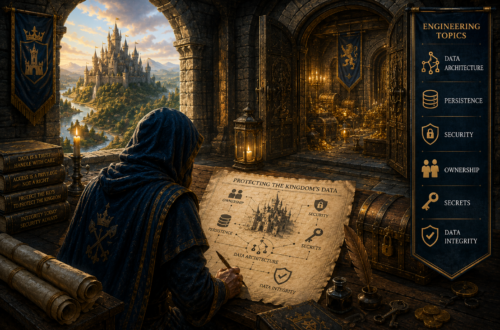
    A hooded royal architect studies a detailed medieval blueprint inside a heavily fortified castle treasury, where secure vaults, locked chests, and guarded passageways symbolize data protection, ownership, persistence, secrets management, and data integrity. Through a large stone archway, a majestic castle overlooks a peaceful river valley, reinforcing the theme that strong software architecture protects an organization's most valuable assets through thoughtful design rather than visible defenses alone.

    The Royal Treasury: Protecting the Kingdom’s Data

    July 10, 2026
    A fantasy-inspired illustration depicts a master engineer overlooking a thriving medieval kingdom powered by invisible systems rather than heroic effort. In the foreground, a cloaked architect studies a blueprint illustrating a software delivery pipeline from code to build, test, deployment, and monitoring. Below, workshops, waterwheels, bridges, and aqueducts symbolize automated infrastructure supporting the bustling city above. Watchtowers overlook the realm while illuminated engineering panels represent automated testing, CI/CD pipelines, infrastructure as code, deployment automation, and monitoring. The scene conveys how automation, continuous improvement, and dependable engineering systems quietly enable a prosperous kingdom without drawing attention to themselves.

    The Automated Kingdom: When Excellence Becomes Routine

    July 22, 2026
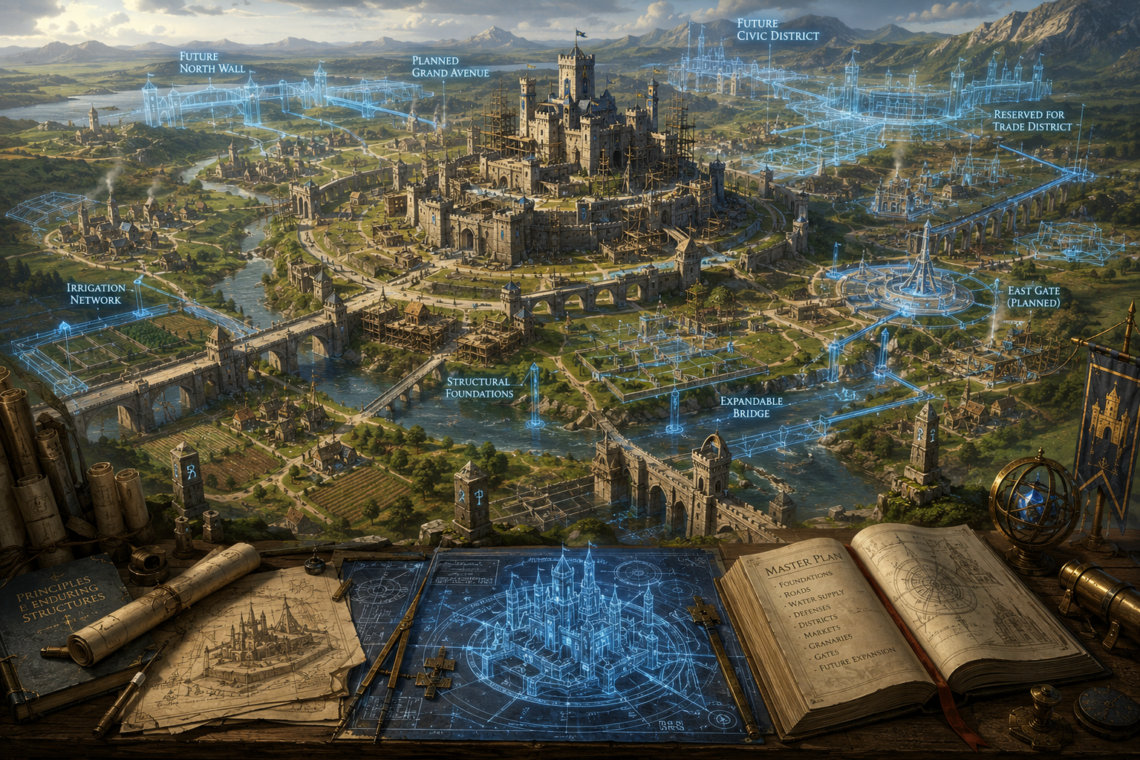
  • A panoramic fantasy kingdom is shown in the early stages of carefully planned expansion, centered on a partially completed stone castle surrounded by villages, bridges, roads, and farmland. Glowing blue architectural overlays, magical surveying grids, and blueprint-style projections illustrate future city walls, districts, bridges, and infrastructure without physically constructing them. In the foreground, an architect's drafting table holds illuminated blueprints, manuscripts, measuring tools, compasses, and engineering instruments, reinforcing the theme of deliberate planning and long-term design. The peaceful medieval landscape emphasizes thoughtful growth, maintainability, and architectural foresight in a classic Dungeons & Dragons-inspired editorial fantasy style.
    The Architect's Grimoire

    Building for Today’s Quest or Tomorrow’s Empire?

    July 1, 2026 /

    Every shortcut is a promise the future must eventually keep. The First Road Beyond the Castle Gates Long before a kingdom becomes an empire, someone chooses where the first road will be built. Travelers may never remember who laid those stones, but generations will depend upon the decision. Software is built much the same way. Long before users celebrate new features, someone quietly decides how the application will grow, how its parts will work together, and whether future engineers will inherit a thriving kingdom or spend their days repairing crumbling foundations. When I first began writing software, I believed every project had a finish line. Complete the feature, fix the…

    Read More
    Frank Jamison

    You May Also Like

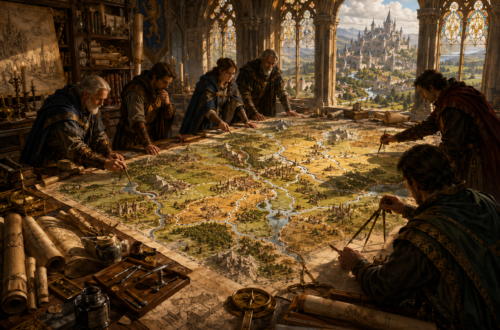
    A group of royal architects and cartographers gather around a massive illuminated kingdom map inside an ornate medieval planning hall. Using compasses, rulers, and drafting tools, they carefully define provincial boundaries that follow rivers, mountains, and trade routes. Shelves filled with scrolls, blueprints, and surveying instruments surround the room, while stained-glass windows reveal a thriving kingdom beyond. The detailed fantasy scene symbolizes thoughtful software architecture by illustrating the deliberate planning and organization required to establish meaningful boundaries within a growing system.

    Dividing the Kingdom: Finding the Right Boundaries

    July 8, 2026
    A hooded royal architect studies a detailed medieval blueprint inside a heavily fortified castle treasury, where secure vaults, locked chests, and guarded passageways symbolize data protection, ownership, persistence, secrets management, and data integrity. Through a large stone archway, a majestic castle overlooks a peaceful river valley, reinforcing the theme that strong software architecture protects an organization's most valuable assets through thoughtful design rather than visible defenses alone.

    The Royal Treasury: Protecting the Kingdom’s Data

    July 10, 2026
    A fantasy-inspired illustration depicts a master engineer overlooking a thriving medieval kingdom powered by invisible systems rather than heroic effort. In the foreground, a cloaked architect studies a blueprint illustrating a software delivery pipeline from code to build, test, deployment, and monitoring. Below, workshops, waterwheels, bridges, and aqueducts symbolize automated infrastructure supporting the bustling city above. Watchtowers overlook the realm while illuminated engineering panels represent automated testing, CI/CD pipelines, infrastructure as code, deployment automation, and monitoring. The scene conveys how automation, continuous improvement, and dependable engineering systems quietly enable a prosperous kingdom without drawing attention to themselves.

    The Automated Kingdom: When Excellence Becomes Routine

    July 22, 2026
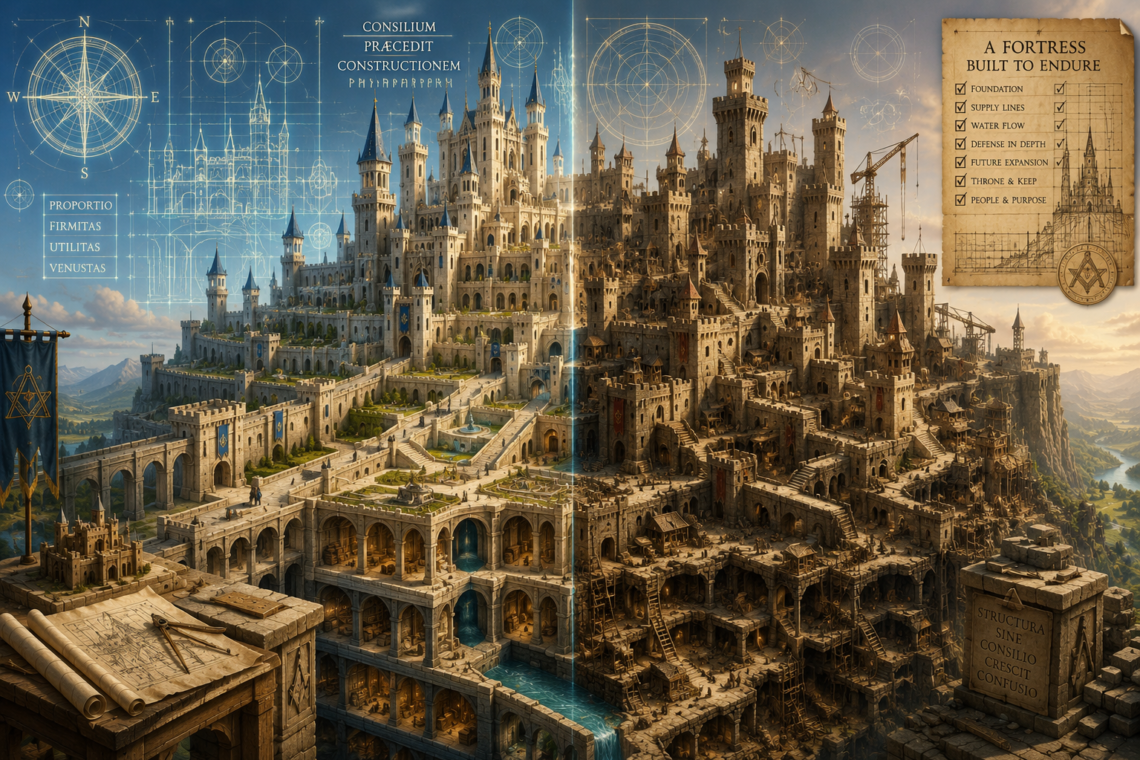
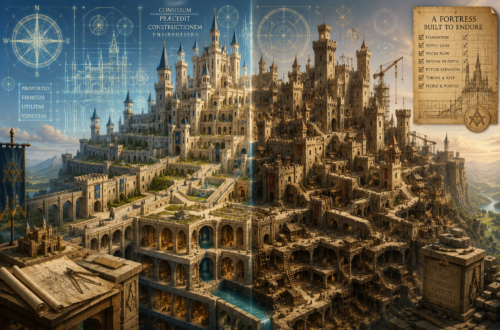
  • A vast medieval fantasy castle dominates the landscape, split into two contrasting halves to illustrate the importance of architectural planning. The left side features a beautifully organized fortress with symmetrical towers, interconnected courtyards, bridges, aqueducts, and orderly roads, overlaid with glowing magical blueprints, surveying grids, compass roses, and geometric construction diagrams. The right side remains impressive but is visibly less organized, with awkward tower placement, inefficient stairways, conflicting roads, and haphazard expansions that suggest growth without an overall plan. Artistic cutaway sections reveal deep stone foundations, underground chambers, drainage tunnels, and structural supports extending into bedrock. Tiny builders and stonemasons emphasize the immense scale of the castle, while warm morning light highlights the contrast between intentional design and organic growth, visually representing the role of software architecture in creating maintainable, long-lasting systems.
    The Architect's Grimoire

    Why Castles Need Architects

    June 29, 2026 /

    Even the finest builders need someone who can see beyond the next wall. Foundations of the Kingdom Maintaining software taught me lessons that writing software never could. Early in my career, I assumed difficult applications were usually the result of poor programming. Whenever a simple change required hours of investigation, I expected to uncover careless decisions, rushed deadlines, or code that had simply been neglected for too long. The more systems I inherited, however, the less convincing that explanation became. Different companies, different teams, and different programming languages produced remarkably similar maintenance problems. As we begin Foundations of the Kingdom, one lesson rises above all the others: every enduring kingdom…

    Read More
    Frank Jamison

    You May Also Like

    A hooded royal architect studies a detailed medieval blueprint inside a heavily fortified castle treasury, where secure vaults, locked chests, and guarded passageways symbolize data protection, ownership, persistence, secrets management, and data integrity. Through a large stone archway, a majestic castle overlooks a peaceful river valley, reinforcing the theme that strong software architecture protects an organization's most valuable assets through thoughtful design rather than visible defenses alone.

    The Royal Treasury: Protecting the Kingdom’s Data

    July 10, 2026
    A sprawling medieval fantasy kingdom stretches across a lush valley, with a fortified castle serving as the central hub of an expansive network of roads, bridges, and satellite settlements that symbolize a scalable software architecture. A massive dragon circles above the kingdom, representing the challenges of system growth, while an architect studies detailed plans from a stone overlook in the foreground. Glowing pathways connect infrastructure throughout the realm, illustrating concepts such as load balancing, distributed systems, caching, and scalable services. The scene emphasizes thoughtful planning, resilient infrastructure, and measured expansion through richly detailed architecture and environmental storytelling, using a classic Dungeons & Dragons-inspired aesthetic to visualize modern software engineering principles.

    The Dragon Named Scale: Building Systems That Grow

    July 13, 2026
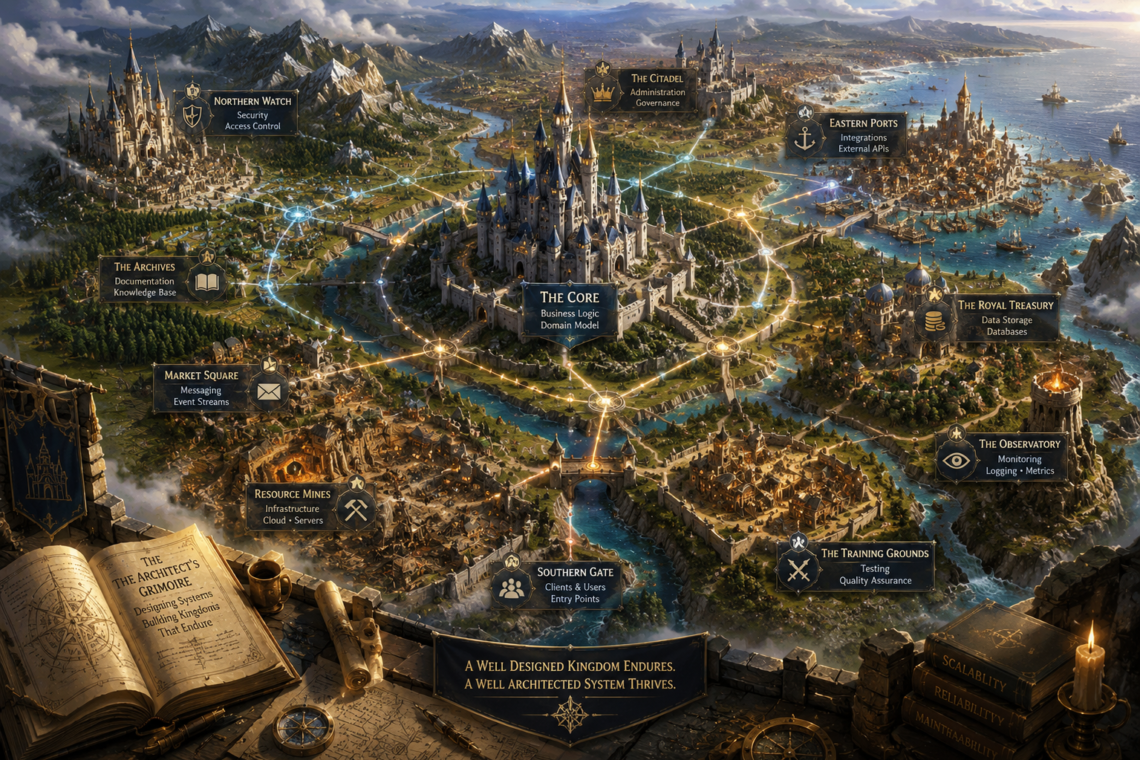
    An epic fantasy map-style illustration depicts a thriving kingdom viewed from above, with a grand central castle labeled "The Core" connected by glowing roads and magical pathways to surrounding regions. Each district represents a software architecture concept, including Northern Watch (Security and Access Control), Eastern Ports (Integrations and External APIs), The Royal Treasury (Data Storage and Databases), The Observatory (Monitoring and Metrics), The Training Grounds (Testing and Quality Assurance), Market Square (Messaging and Event Streams), Resource Mines (Infrastructure and Servers), The Archives (Documentation and Knowledge Base), and Southern Gate (Clients and Users). In the foreground, an open book titled The Architect's Grimoire rests on a stone table alongside maps, drafting tools, and architectural plans. A banner reads, "A Well Designed Kingdom Endures. A Well Architected System Thrives." The image uses fantasy kingdom imagery to visualize software architecture as an interconnected, carefully planned realm.

    Building Kingdoms That Endure

    June 28, 2026
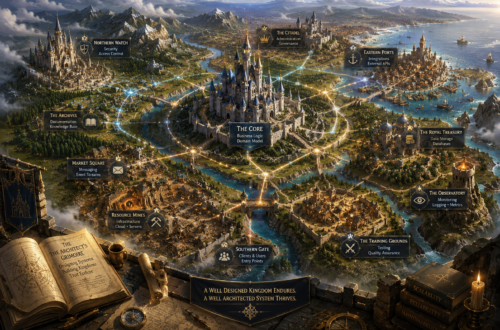
  • An epic fantasy map-style illustration depicts a thriving kingdom viewed from above, with a grand central castle labeled "The Core" connected by glowing roads and magical pathways to surrounding regions. Each district represents a software architecture concept, including Northern Watch (Security and Access Control), Eastern Ports (Integrations and External APIs), The Royal Treasury (Data Storage and Databases), The Observatory (Monitoring and Metrics), The Training Grounds (Testing and Quality Assurance), Market Square (Messaging and Event Streams), Resource Mines (Infrastructure and Servers), The Archives (Documentation and Knowledge Base), and Southern Gate (Clients and Users). In the foreground, an open book titled The Architect's Grimoire rests on a stone table alongside maps, drafting tools, and architectural plans. A banner reads, "A Well Designed Kingdom Endures. A Well Architected System Thrives." The image uses fantasy kingdom imagery to visualize software architecture as an interconnected, carefully planned realm.
    The Architect's Grimoire

    Building Kingdoms That Endure

    June 28, 2026 /

    Every enduring kingdom begins with a blueprint. Every developer learns to build. The best developers learn what to build next. No kingdom becomes legendary because its masons laid beautiful stones. No empire survives because its carpenters built magnificent gates or its blacksmiths forged exceptional swords. History remembers kingdoms that endured because someone looked beyond the next building and imagined how an entire realm would one day function. Roads connected cities before merchants ever traveled them. Walls protected districts that had not yet been built. Aqueducts carried water to neighborhoods that existed only on parchment. Long before the first stone was laid, someone had already begun designing the future. Software follows…

    Read More
    Frank Jamison

    You May Also Like

    A fantasy-inspired illustration depicts a master engineer overlooking a thriving medieval kingdom powered by invisible systems rather than heroic effort. In the foreground, a cloaked architect studies a blueprint illustrating a software delivery pipeline from code to build, test, deployment, and monitoring. Below, workshops, waterwheels, bridges, and aqueducts symbolize automated infrastructure supporting the bustling city above. Watchtowers overlook the realm while illuminated engineering panels represent automated testing, CI/CD pipelines, infrastructure as code, deployment automation, and monitoring. The scene conveys how automation, continuous improvement, and dependable engineering systems quietly enable a prosperous kingdom without drawing attention to themselves.

    The Automated Kingdom: When Excellence Becomes Routine

    July 22, 2026
    A vast medieval fantasy castle dominates the landscape, split into two contrasting halves to illustrate the importance of architectural planning. The left side features a beautifully organized fortress with symmetrical towers, interconnected courtyards, bridges, aqueducts, and orderly roads, overlaid with glowing magical blueprints, surveying grids, compass roses, and geometric construction diagrams. The right side remains impressive but is visibly less organized, with awkward tower placement, inefficient stairways, conflicting roads, and haphazard expansions that suggest growth without an overall plan. Artistic cutaway sections reveal deep stone foundations, underground chambers, drainage tunnels, and structural supports extending into bedrock. Tiny builders and stonemasons emphasize the immense scale of the castle, while warm morning light highlights the contrast between intentional design and organic growth, visually representing the role of software architecture in creating maintainable, long-lasting systems.

    Why Castles Need Architects

    June 29, 2026
    A fantasy-inspired digital illustration depicts a royal architect standing over maps and plans as a massive stone castle burns under a night sky filled with flaming projectiles. Although sections of the fortress are engulfed in flames, smaller fortified districts below remain connected by glowing blue pathways, symbolizing resilient system architecture and fault isolation. Floating holographic icons represent High Availability, Backups, Disaster Recovery, Fault Tolerance, and Incident Response, visually linking medieval defenses with modern software engineering concepts. Scrolls and architectural plans in the foreground reinforce themes of preparation, recovery, and thoughtful design, while the dramatic contrast between destruction and continuity emphasizes that resilient systems are designed to withstand failure rather than prevent it entirely.

    When the Kingdom Burns: Designing for Failure Before Disaster Strikes

    July 17, 2026
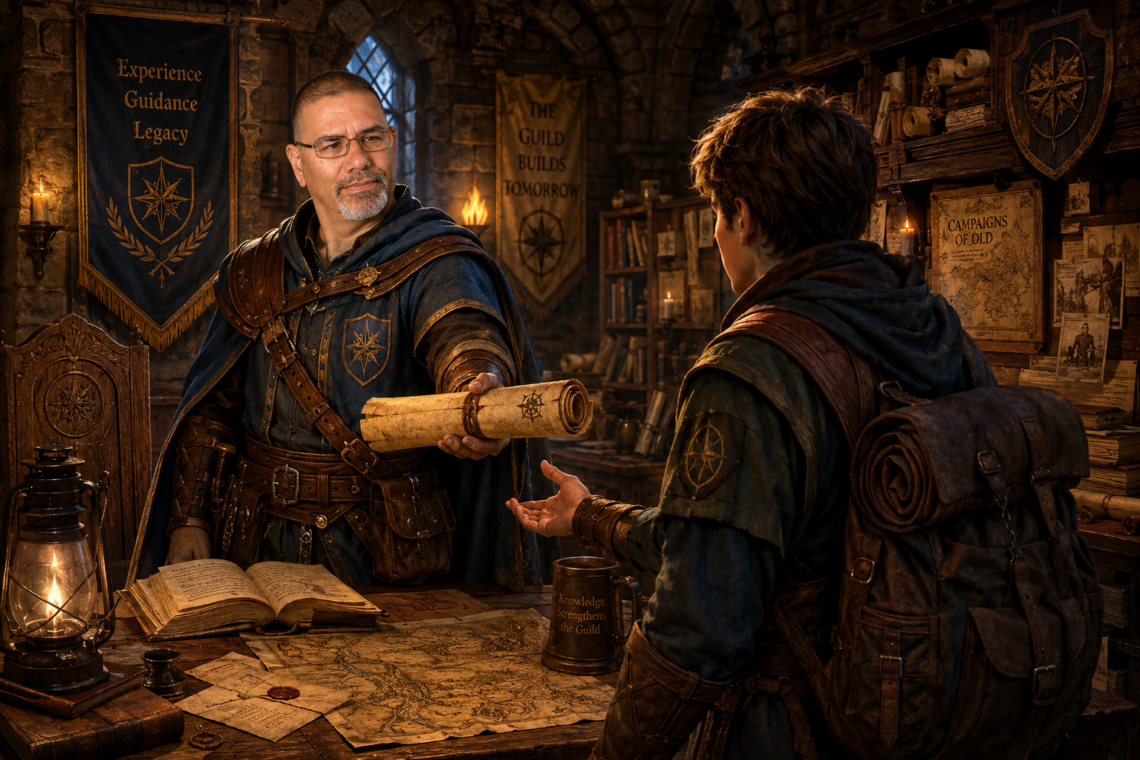
  • Frank Jamison, depicted as an experienced fantasy guildmaster, stands inside a warmly lit medieval guild hall and hands a rolled parchment map to a young adventurer preparing for a journey. Wearing practical adventuring gear and guildmaster robes, he appears confident, patient, and encouraging. The hall is filled with maps, books, scrolls, and records of past adventures, with banners emphasizing experience, guidance, and legacy. The scene symbolizes mentorship, knowledge sharing, and helping the next generation of adventurers find their path.
    The Guildmaster’s Handbook

    Becoming the Developer You Once Needed

    June 26, 2026 /

    The greatest guides are often those who remember what it felt like to walk alone. The Veteran at the Tavern Table One of the most surprising lessons I have learned throughout my career is that software development is not ultimately about software. The code matters. The systems matter. The architecture matters. Yet when I look back on the people who changed my career, I do not remember them primarily because of the software they built. I remember them because of the guidance they provided when I needed it most. Over time, I came to realize that the final stage of becoming a developer is not mastering technology. It is becoming…

    Read More
    Frank Jamison

    You May Also Like

    Frank Jamison, depicted as a seasoned guildmaster and mentor, leads a group of younger adventurers at sunrise while gathered around a large map beside a mountain crossroads. Wearing practical fantasy adventuring attire, he points toward multiple roads stretching through forests, valleys, mountains, and distant cities, symbolizing different technology career paths. Around the group are travel wagons, lanterns, books, engineering diagrams, code-filled scrolls, learning roadmaps, and quest logs that represent sustainable skill development. A towering signpost lists various specialties, including web development, cloud architecture, cybersecurity, and machine learning. The scene emphasizes mentorship, planning, endurance, and choosing a path wisely, with warm golden light illuminating the vast landscape and reinforcing the article's theme of learning without burning out.

    Learning Without Burning Out

    June 3, 2026
    Frank Jamison, portrayed as a seasoned guildmaster in a medieval fantasy guild hall, calmly studies a simple quest contract while a massive mimic-like monster made of scrolls, requirements documents, project plans, diagrams, and task lists erupts across a wooden strategy table. The paper creature's tendrils spread through the room, consuming timelines, architecture diagrams, and engineering blueprints as nearby adventurers react with alarm. Warm torchlight illuminates the scene, symbolizing the dangers of scope creep in software development and project management.

    Scope Creep and Other Predators

    June 17, 2026
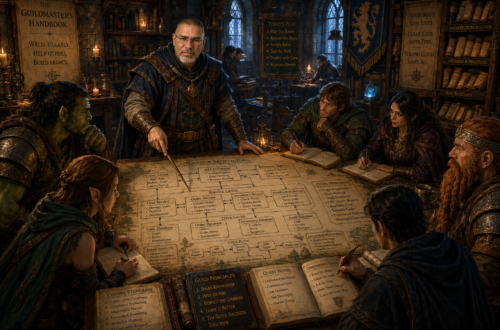
    Frank Jamison, portrayed as a seasoned guildmaster and veteran adventurer, stands at the center of a bustling fantasy guild hall, guiding a diverse group of adventurers around a massive strategy table. The table is covered with detailed architectural diagrams, software-inspired maps, flowcharts, and handwritten guild principles rendered as medieval cartography. Shelves of scrolls, books, and guild records line the walls, while lanterns and warm candlelight illuminate the collaborative scene. Adventurers of multiple races and classes study notes, discuss plans, and learn from Frank's guidance. The image symbolizes code readability, mentorship, onboarding, documentation, and teamwork through visual metaphors of maps, pathways, and shared knowledge within a thriving adventurer's guild.

    Writing Code Others Can Read

    June 8, 2026
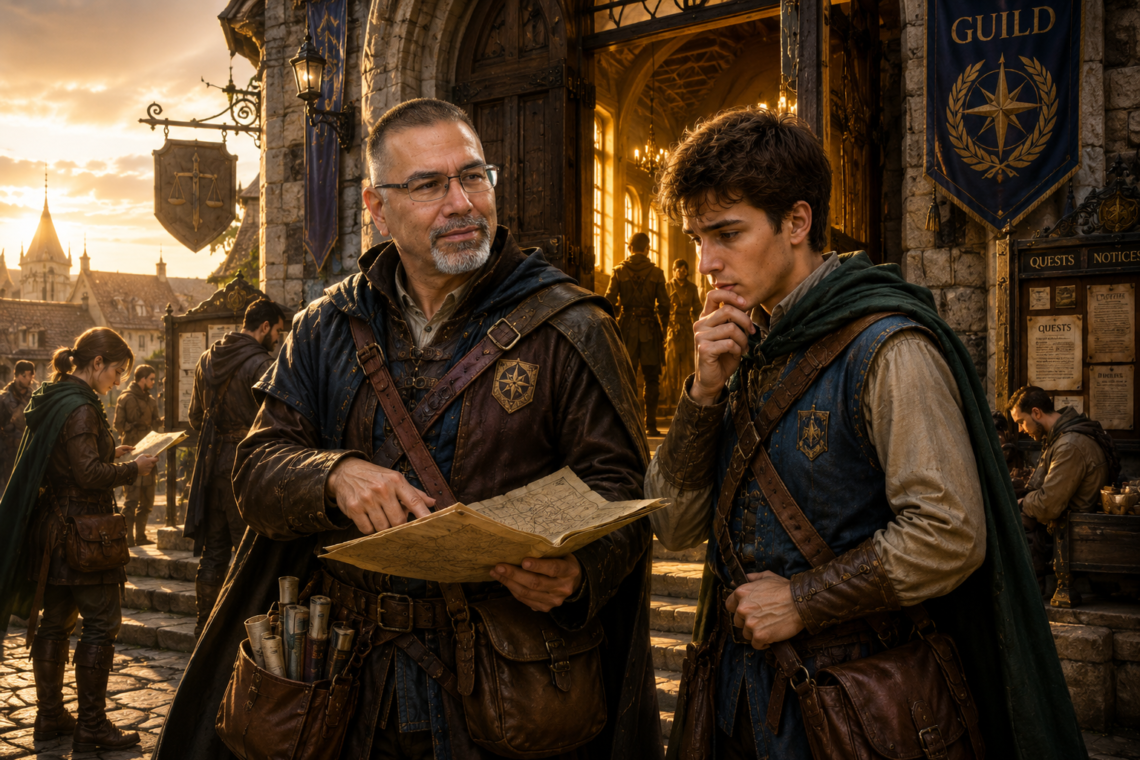
  • Frank Jamison portrayed as a veteran guildmaster mentoring a nervous young adventurer outside a grand fantasy guild hall at dawn, reviewing a map while adventurers prepare for quests in the background.
    The Guildmaster’s Handbook

    Interviews Without Panic Damage

    June 24, 2026 /

    Confidence is not knowing every answer. It is learning to stand steady when questions come. The Interview Hall Awaits I have seen more developers wounded by interview anxiety than by technical difficulty. Throughout my career, I have watched capable developers walk into interviews carrying more fear than the encounter deserved. They had built projects, solved real problems, learned difficult tools, and survived the long grind of becoming employable in a field that rarely hands out easy victories. Yet the moment the interview began, they treated the conversation like the final chamber of a cursed dungeon. Every question sounded like a trap, every pause felt like judgment, and every imperfect answer…

    Read More
    Frank Jamison

    You May Also Like

    Frank Jamison, portrayed as a seasoned guildmaster adventurer, stands at the center of a grand medieval guild hall strategy table covered with maps, contracts, architectural blueprints, engineering schematics, and glowing magical diagrams. Surrounded by representatives of merchants, nobility, scholars, quartermasters, and city officials, he calmly mediates a discussion while gesturing toward an illuminated map displaying interconnected pathways across the kingdom. Warm torchlight and cool magical light fill the bustling stone hall, emphasizing leadership, collaboration, communication, and problem-solving in a richly detailed fantasy setting inspired by Dungeons & Dragons.

    Working With Stakeholders Without Losing Sanity

    June 12, 2026
    Frank Jamison, depicted as a fantasy guildmaster and technical mentor, stands at the center of a grand medieval archive while teaching four apprentice developers gathered around a large wooden table. Open books, architectural diagrams, software design sketches, code examples, and project notes cover the table. Magical blue holographic displays show project dashboards, technology stacks, and source code floating among towering bookshelves. Warm sunlight streams through stained-glass windows decorated with castles, dragons, and software symbols, creating an inspiring atmosphere that blends software engineering, mentorship, and high fantasy.

    Building a Portfolio Worth Showing

    June 22, 2026
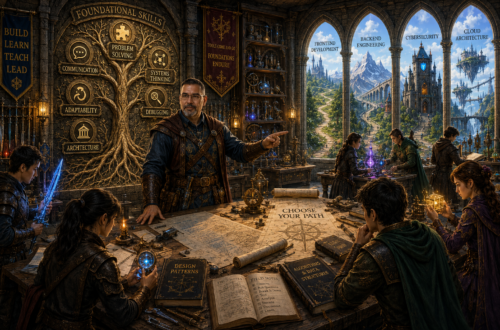
    Frank Jamison, portrayed as a seasoned guildmaster and veteran engineer, stands in a grand fantasy training hall guiding young adventurers toward foundational skills rather than magical treasures. A towering stone skill tree labeled Communication, Problem Solving, Systems Thinking, Adaptability, Debugging, and Architecture dominates the wall behind him. Apprentices study maps, engineering blueprints, notebooks, drafting tools, and glowing artifacts around a massive wooden training table marked Choose Your Path. Through large arched windows, fantasy landscapes represent different technology career paths including Frontend Development, Backend Engineering, Cybersecurity, and Cloud Architecture. Warm torchlight and subtle blue magical illumination create a wise, instructional atmosphere emphasizing mentorship, learning, and long-term skill development.

    Building Skills That Actually Matter

    June 5, 2026
  • Frank Jamison, depicted as a fantasy guildmaster and technical mentor, stands at the center of a grand medieval archive while teaching four apprentice developers gathered around a large wooden table. Open books, architectural diagrams, software design sketches, code examples, and project notes cover the table. Magical blue holographic displays show project dashboards, technology stacks, and source code floating among towering bookshelves. Warm sunlight streams through stained-glass windows decorated with castles, dragons, and software symbols, creating an inspiring atmosphere that blends software engineering, mentorship, and high fantasy.
    The Guildmaster’s Handbook

    Building a Portfolio Worth Showing

    June 22, 2026 /

    Good work deserves witnesses. Build proof of the journey, not merely trophies. Every Adventurer Needs a Record of Their Journey One of the most common mistakes I see newer developers make is treating a portfolio as something they will build someday. They imagine a future version of themselves who has completed enough projects, learned enough technologies, and accumulated enough experience to finally deserve a public showcase. Until that day arrives, they keep their work hidden inside repositories, forgotten folders, abandoned cloud accounts, and unfinished side projects. Unfortunately, that approach creates a serious problem. By the time they decide they need a portfolio, much of the journey that would have made…

    Read More
    Frank Jamison

    You May Also Like

    Frank Jamison, portrayed as a seasoned guildmaster and veteran adventurer, stands at the center of a bustling fantasy guild hall, guiding a diverse group of adventurers around a massive strategy table. The table is covered with detailed architectural diagrams, software-inspired maps, flowcharts, and handwritten guild principles rendered as medieval cartography. Shelves of scrolls, books, and guild records line the walls, while lanterns and warm candlelight illuminate the collaborative scene. Adventurers of multiple races and classes study notes, discuss plans, and learn from Frank's guidance. The image symbolizes code readability, mentorship, onboarding, documentation, and teamwork through visual metaphors of maps, pathways, and shared knowledge within a thriving adventurer's guild.

    Writing Code Others Can Read

    June 8, 2026
    Frank Jamison, depicted as an experienced fantasy guildmaster, stands inside a warmly lit medieval guild hall and hands a rolled parchment map to a young adventurer preparing for a journey. Wearing practical adventuring gear and guildmaster robes, he appears confident, patient, and encouraging. The hall is filled with maps, books, scrolls, and records of past adventures, with banners emphasizing experience, guidance, and legacy. The scene symbolizes mentorship, knowledge sharing, and helping the next generation of adventurers find their path.

    Becoming the Developer You Once Needed

    June 26, 2026
    Frank Jamison, portrayed as a seasoned guildmaster and veteran engineer, stands in a grand fantasy training hall guiding young adventurers toward foundational skills rather than magical treasures. A towering stone skill tree labeled Communication, Problem Solving, Systems Thinking, Adaptability, Debugging, and Architecture dominates the wall behind him. Apprentices study maps, engineering blueprints, notebooks, drafting tools, and glowing artifacts around a massive wooden training table marked Choose Your Path. Through large arched windows, fantasy landscapes represent different technology career paths including Frontend Development, Backend Engineering, Cybersecurity, and Cloud Architecture. Warm torchlight and subtle blue magical illumination create a wise, instructional atmosphere emphasizing mentorship, learning, and long-term skill development.

    Building Skills That Actually Matter

    June 5, 2026
  • Frank Jamison, depicted as a seasoned adventurer-engineer, studies a large map at a guild hall worktable covered with architectural diagrams, engineering blueprints, books, scrolls, and magical instruments. Behind him looms a towering shadowy creature formed from smoke and mist, symbolizing impostor syndrome. Warm torchlight illuminates the stone chamber, highlighting symbols of past achievements, knowledge, and experience. The scene blends medieval fantasy and software engineering themes to represent overcoming self-doubt through wisdom, perseverance, and hard-earned expertise.
    The Guildmaster’s Handbook

    When Impostor Syndrome Rolls a Critical Hit

    June 19, 2026 /

    Even seasoned adventurers sometimes mistake uncertainty for failure. The Trial Hidden Behind the Character Sheet During this week’s theme, The Trials of the Realm, it would be easy to focus exclusively on technical challenges. We could discuss production outages, difficult debugging sessions, complex architectures, or impossible deadlines. Those are certainly trials every engineer encounters. Yet one of the most persistent challenges I have faced throughout my career never appeared in a ticketing system, generated an error message, or triggered an alert. It appeared quietly in my own thinking and attempted to convince me that I did not belong where I had already earned the right to stand. Impostor syndrome is…

    Read More
    Frank Jamison

    You May Also Like

    Frank Jamison, portrayed as a seasoned guildmaster and adventurer, stands at the head of a large strategy table inside a warmly lit medieval guild hall. Around him, a diverse party of adventurers including a wizard, ranger, cleric, rogue, and artificer collaboratively review a glowing magical blueprint filled with software architecture diagrams, annotated notes, and arcane symbols. Shelves of books and scrolls line the stone walls, while lanterns and blue magical runes illuminate the room. The scene symbolizes constructive code reviews, teamwork, mentorship, and professional growth within a fantasy-inspired guild setting.

    Code Reviews Without Emotional Damage

    June 10, 2026
    Frank Jamison, depicted as a seasoned Guildmaster and software engineer, studies a detailed architectural map inside a vast underground fantasy ruin representing a legacy software system. Wearing practical adventurer-scholar gear and holding a lantern, he stands at a stone table surrounded by guild journals, engineering records, maps, and ancient scrolls. Glowing blue runes resembling source code, database diagrams, and system architecture cover the dungeon walls. Nearby, a collapsed passage marked Failed Rewrite, a monument labeled Technical Debt, hidden doors representing undocumented features, and magical wards protecting explored areas symbolize the challenges of maintaining legacy code. The cinematic scene conveys exploration, problem-solving, knowledge preservation, and the careful navigation of complex software systems.

    Legacy Code and Ancient Curses

    June 15, 2026
    Frank Jamison, portrayed as a seasoned guildmaster and veteran engineer, stands in a grand fantasy training hall guiding young adventurers toward foundational skills rather than magical treasures. A towering stone skill tree labeled Communication, Problem Solving, Systems Thinking, Adaptability, Debugging, and Architecture dominates the wall behind him. Apprentices study maps, engineering blueprints, notebooks, drafting tools, and glowing artifacts around a massive wooden training table marked Choose Your Path. Through large arched windows, fantasy landscapes represent different technology career paths including Frontend Development, Backend Engineering, Cybersecurity, and Cloud Architecture. Warm torchlight and subtle blue magical illumination create a wise, instructional atmosphere emphasizing mentorship, learning, and long-term skill development.

    Building Skills That Actually Matter

    June 5, 2026
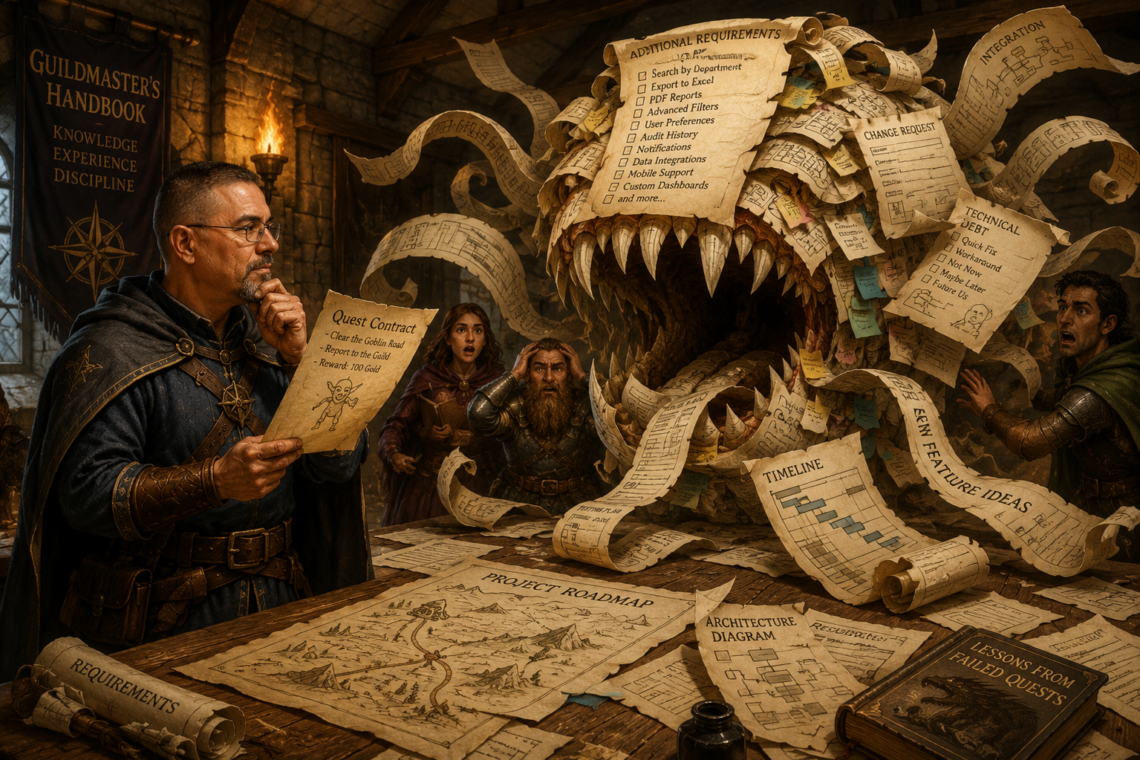
  • Frank Jamison, portrayed as a seasoned guildmaster in a medieval fantasy guild hall, calmly studies a simple quest contract while a massive mimic-like monster made of scrolls, requirements documents, project plans, diagrams, and task lists erupts across a wooden strategy table. The paper creature's tendrils spread through the room, consuming timelines, architecture diagrams, and engineering blueprints as nearby adventurers react with alarm. Warm torchlight illuminates the scene, symbolizing the dangers of scope creep in software development and project management.
    The Guildmaster’s Handbook

    Scope Creep and Other Predators

    June 17, 2026 /

    Beware the quest that quietly grows teeth while nobody is paying attention. The Monster Nobody Notices Throughout my career in software development, I have learned that some of the most dangerous project threats are not technical in nature. Bugs can be identified, analyzed, and fixed. Performance bottlenecks can be measured and optimized. Infrastructure failures can usually be diagnosed through careful investigation and experience. Scope creep is different because it rarely presents itself as a problem at the beginning. Instead, it often arrives disguised as a helpful suggestion, a reasonable enhancement, or an opportunity to improve the final product. Left unmanaged, those small additions accumulate until the original project becomes something…

    Read More
    Frank Jamison

    You May Also Like

    Frank Jamison, depicted as a seasoned adventurer-engineer, studies a large map at a guild hall worktable covered with architectural diagrams, engineering blueprints, books, scrolls, and magical instruments. Behind him looms a towering shadowy creature formed from smoke and mist, symbolizing impostor syndrome. Warm torchlight illuminates the stone chamber, highlighting symbols of past achievements, knowledge, and experience. The scene blends medieval fantasy and software engineering themes to represent overcoming self-doubt through wisdom, perseverance, and hard-earned expertise.

    When Impostor Syndrome Rolls a Critical Hit

    June 19, 2026
    Frank Jamison, depicted as a seasoned guildmaster and mentor, leads a group of younger adventurers at sunrise while gathered around a large map beside a mountain crossroads. Wearing practical fantasy adventuring attire, he points toward multiple roads stretching through forests, valleys, mountains, and distant cities, symbolizing different technology career paths. Around the group are travel wagons, lanterns, books, engineering diagrams, code-filled scrolls, learning roadmaps, and quest logs that represent sustainable skill development. A towering signpost lists various specialties, including web development, cloud architecture, cybersecurity, and machine learning. The scene emphasizes mentorship, planning, endurance, and choosing a path wisely, with warm golden light illuminating the vast landscape and reinforcing the article's theme of learning without burning out.

    Learning Without Burning Out

    June 3, 2026
    Frank Jamison, depicted as an experienced fantasy guildmaster, stands inside a warmly lit medieval guild hall and hands a rolled parchment map to a young adventurer preparing for a journey. Wearing practical adventuring gear and guildmaster robes, he appears confident, patient, and encouraging. The hall is filled with maps, books, scrolls, and records of past adventures, with banners emphasizing experience, guidance, and legacy. The scene symbolizes mentorship, knowledge sharing, and helping the next generation of adventurers find their path.

    Becoming the Developer You Once Needed

    June 26, 2026
23456
  • The Architect's Grimoire (13)
  • The CSS Codex (13)
  • The Enchanted Workshop (13)
  • The Full-Stack Campaign (8)
  • The Guildmaster’s Handbook (13)
  • The Kingdom in the Clouds (9)

AI-Assisted Development Artificial Intelligence Backend Development Career Development Clean Code Cloud-Native Architecture Code Quality CSS Architecture CSS Best Practices Design Systems Developer Growth Developer Productivity Distributed Systems Dungeons and Dragons Engineering Culture Engineering Judgment Engineering Leadership Fantasy Theme Front-End Development Frontend Development Full Stack Development Human-AI Collaboration Maintainable Code Maintainable CSS Mentorship Professional Development Professional Growth Refactoring Responsive Design Software Architecture Software Craftsmanship Software Design Software Development Software Engineering StackNScroll System Design Technical Debt Technical Leadership The Architect's Grimoire The CSS Codex The Enchanted Workshop The Full-Stack Campaign The Guildmaster's Handbook The Kingdom in the Clouds Web Development

Stack N' Scroll - 2026 ©