• Stamp Evaluation – Scott #985 (Used, Hinged, No Original Gum – Single Stamp) 3¢ Carmine Rose – Grand Army of the Republic, 1949 (Commemorative Issue – Rotary Press Printing, Perf 11 x 10½, Unwatermarked) Design Overview: Scott #985 commemorates the final national encampment of the Grand Army of the Republic. The design features an elderly Civil War veteran in the foreground, a younger soldier behind him, and the GAR emblem at left above the denomination. “United States Postage” anchors the lower tablet, while the commemorative inscription spans the top. Printed in carmine rose, the engraving retains strong color, clear portrait detail, and good contrast. Grading Breakdown: The centering grade is Fine/Very Fine 78. Visually, with the unaided eye, the perforation holes are easily seen to be clear of the design, but one or two margins are narrow. The bottom margin is the most narrow and establishes the centering limit. The left margin is the least narrow, while the right margin is more narrow than the top. All margins remain clearly outside the design and satisfy the Fine/Very Fine standard. The stamp presents pleasing overall balance, with the lower margin as the primary visual limitation. Soundness Evaluation: The faults present are two shorter perforations approximately half normal length and four fuzzy or ragged perforations. These faults constitute Minor Fault soundness. Minor Fault soundness combined with Fine/Very Fine centering yields a preliminary grade of Very Good 58. The group of shortened and ragged perforations is the controlling condition issue, while the stamp otherwise retains a clean appearance. Perforations and Margins: The perforations are generally complete, but several teeth show the shortened, fuzzy, or ragged condition noted in the fault list. These irregularities slightly soften the otherwise clean outline of the stamp. The bottom margin is closest to the design, the left margin is widest, and the right margin is narrower than the top. The frame remains visibly clear of the perforation holes on all four sides. Cancellation Evaluation: No visible cancellation appears on the face of the stamp. The portraits, GAR emblem, denomination, top inscription, and lower tablet are fully visible without postal markings crossing the design. For a used stamp, this creates a clean front presentation, though the absence of a visible cancel is treated conservatively and does not automatically produce a grade increase. Collector’s Note: Scott #985 is a historically appealing commemorative for collectors of Civil War memory, veterans’ organizations, patriotic themes, and late 1940s United States issues. The paired veteran-and-soldier design gives the stamp strong symbolic impact. Eye Appeal Adjustment: After centering and soundness are determined, eye appeal is considered. The stamp retains fresh carmine rose color, a sharp engraved impression, and an unobstructed design. The perforation faults have already been accounted for in soundness, and there is no heavy cancellation to penalize. No additional adjustment is warranted, so the preliminary grade remains 58. Final Numerical Grade Calculation: The centering grade is Fine/Very Fine 78. Minor Fault soundness reduces the grade by 20 points, producing a preliminary grade of Very Good 58. No cancellation deduction or other eye appeal adjustment is applied. The final numerical grade is 58. Summary: This used Scott #985 shows Fine/Very Fine 78 centering, with the bottom margin most narrow, the left margin widest, and the right margin narrower than the top. Minor Fault soundness lowers the preliminary grade to Very Good 58. Clean color and an unobstructed face support the result without changing it. Final Grade: Very Good 58.
    The Full-Stack Campaign

    The First Map: How the Browser Shapes the World

    Every adventure begins with understanding the terrain beneath your feet. Editor’s Note: This article is an expanded and revised edition of a piece originally published on RandomThoughtsInTraffic.com. For its StackNScroll release, the material has been substantially updated with deeper coverage of browser architecture, rendering behavior, document parsing, resource loading, and the relationship between structure, presentation, and interactivity. New sections have been added to explain the browser’s rendering pipeline, introduce foundational performance concepts, and establish the technical groundwork for future articles in The Full-Stack Campaign. As part of this week’s Foundations of the Realm theme, the goal is to help readers develop accurate mental models of how browsers transform source code…

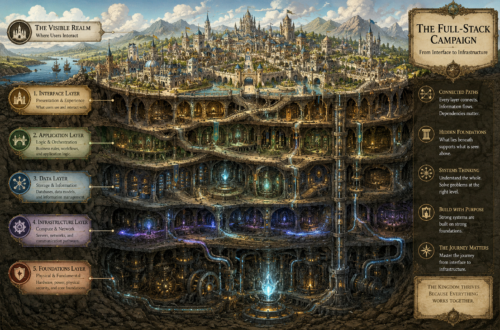
  • Detailed fantasy cross-section illustration titled The Full-Stack Campaign: From Interface to Infrastructure. A sprawling medieval fantasy kingdom filled with castles, towers, bridges, marketplaces, and guild halls sits on the surface beneath a bright sky. The ground beneath the city is cut away to reveal multiple interconnected underground layers extending deep into the earth. Massive stone roads, elevators, tunnels, aqueducts, glowing magical conduits, and engineering works connect hidden chambers, archives, vaults, transit networks, and subterranean fortresses. The deepest levels contain enormous dwarven-style machinery, crystal power systems, and foundational infrastructure supporting the realm above. Informational panels label each layer of the kingdom, visually illustrating how visible systems depend upon increasingly complex hidden foundations. The image conveys themes of architecture, interconnected systems, dependencies, and the journey from user-facing experiences to the infrastructure that supports them.
    The Full-Stack Campaign

    From Interface to Infrastructure

    Before adventurers can explore the world, they must understand the rules that shape it. Editor’s Note Before appearing as the opening chapter of The Full-Stack Campaign: From Interface to Infrastructure, this article first appeared on RandomThoughtsInTraffic.com as an exploration of why developers often struggle when their knowledge remains confined to a single layer of the technology stack. This revised and expanded edition examines how information travels through modern web applications, explores the relationships between browsers, APIs, servers, databases, and infrastructure, and establishes the systems-oriented mindset that guides the remainder of the series. New material includes expanded architectural examples, a deeper discussion of specialization within software development, and a practical examination…

  • An enormous ancient spellbook rests on a carved stone pedestal in a vast arcane archive as hundreds of stylesheet-like parchment pages erupt from its open pages and merge into a colossal serpentine creature made entirely of CSS rules, annotations, diagrams, revisions, and glowing magical symbols. The parchment monster coils through towering shelves filled with labeled codices while streams of luminous blue and violet magical energy connect scattered documents into a sprawling network of dependencies. Individual pages display selectors, properties, comments, crossed-out declarations, and specificity notes, emphasizing accumulated technical debt and architectural complexity. The scene is illuminated by glowing runes, magical ink, and dramatic volumetric light, creating the impression of a once-useful body of knowledge that has grown beyond its original purpose and become an intelligent living manifestation of an unmaintainable stylesheet.
    The CSS Codex

    When the Stylesheet Becomes the Monster

    Ignore a growing beast long enough and eventually it guards the dungeon. Editor’s Note: This article originally appeared on RandomThoughtsInTraffic.com and has been revised and expanded for StackNScroll as the closing chapter of The CSS Codex. The original edition explored how CSS codebases gradually become more difficult to maintain as shortcuts, overrides, and exceptions accumulate over time. This updated version expands that discussion with deeper examination of architectural drift, technical debt, component design, specificity management, long-term maintenance practices, and the warning signs that experienced engineers learn to recognize before problems become crises. It also serves as a capstone for the broader lessons explored throughout The CSS Codex, bringing together concepts…

  • A massive ancient spellbook rests open on an ornate stone lectern at the center of a grand wizard's archive. The book's pages are filled with intricate geometric diagrams, arcane constructions, layered annotations, and evidence of repeated revisions, including crossed-out symbols and inserted bookmarks. Floating above the spellbook is a complex network of glowing blue and gold magical sigils connected by delicate lines and circular structures, appearing increasingly organized toward the center. Surrounding the lectern are stacks of weathered grimoires, loose parchment diagrams, quills, measuring instruments, compasses, and scholarly tools scattered across a richly detailed workspace. Warm lantern light illuminates the archive while magical energy radiates upward from the book, creating an atmosphere of careful refinement, accumulated knowledge, and the ongoing maintenance of a powerful arcane reference.
    The CSS Codex

    Refactoring the Spellbook

    Every spellbook gathers clutter until a wizard dares to rewrite it. Editor’s Note: This article is an expanded and revised edition of a piece originally published on RandomThoughtsInTraffic.com. While the original article focused primarily on the practical need to clean up aging stylesheets, this StackNScroll edition explores refactoring as a long-term architectural discipline within CSS systems. New material examines design tokens, specificity management, component ownership, incremental refactoring strategies, dead code removal, and the relationship between technical debt and maintainability during long-lived projects. As part of this week’s theme, The Long Campaign, the article focuses on how experienced developers preserve the health of stylesheets over months and years of continuous development,…

  • A grand fantasy chamber deep beneath an ancient royal castle, centered on a massive illuminated stone contract resting atop a circular dais. Golden streams of magical energy radiate from the contract to hundreds of surrounding scrolls, tablets, seals, and carved monuments arranged throughout the vast hall. Above the dais, an intricate network of glowing geometric symbols, circles, and interconnected pathways forms a luminous hierarchy suspended in the air, suggesting authority, inheritance, and shared laws. Towering stone pillars covered in ornate carvings frame the scene, while warm golden light fills the chamber with an atmosphere of governance, order, institutional knowledge, and enduring stewardship. The composition emphasizes a single binding agreement serving as the foundation for an entire realm.
    The CSS Codex

    Variables as Binding Contracts

    Strong kingdoms endure because their laws are written, not remembered. Editor’s Note: This article was originally published on RandomThoughtsInTraffic.com and has been revised and expanded for StackNScroll as part of The CSS Codex series. The original edition introduced CSS variables primarily as a practical mechanism for reducing duplication within stylesheets. This revised version expands that discussion considerably, examining variables as architectural agreements that govern design systems, component behavior, and long-term maintainability. New material explores naming conventions, design token strategies, component contracts, variable inheritance, theming, and how experienced engineers use variables to build systems that remain understandable years after their original implementation. As part of this week’s theme, The Long Campaign,…

  • A colossal ancient stone monument shaped like a towering skill tree rises from the center of a vast mountain valley. Hundreds of glowing blue and gold energy nodes connect through branching pathways, terraces, stairways, and bridges that climb toward a brilliant radiant pinnacle at the summit. The lower levels glow softly while the upper tiers shine with increasingly powerful light, symbolizing growth, mastery, and the compounding value of long-term investment. Surrounding the monument, rivers, roads, distant settlements, and cultivated lands spread across the landscape, suggesting centuries of development fueled by the monument's energy. The scene conveys patience, progression, wisdom, and accumulated experience through an epic fantasy aesthetic.
    The CSS Codex

    Patience Is a Scaling Stat

    The greatest guild halls were not built in a single turn of the hourglass. Editor’s Note: Before joining The CSS Codex: Mastering the Rules of the Realm, Patience Is a Scaling Stat first appeared on RandomThoughtsInTraffic.com. This revised and expanded edition explores the relationship between patience, craftsmanship, and long-term CSS maintainability through the lens of sustainable engineering practices. New material examines how small implementation decisions compound over time, how experienced developers approach architectural choices differently than newer practitioners, and why understanding systems often matters more than solving individual problems quickly. While the original article focused primarily on professional growth and mindset, this edition connects those lessons directly to CSS architecture,…

  • A vast circular stone chamber resembling an ancient arcane observatory is arranged in perfect symmetry around a glowing geometric artifact suspended at its exact center. Concentric rings, compass-like construction lines, and luminous geometric patterns radiate outward across the floor, while towering stone pillars and vaulted arches surround the space. Blue and gold magical energy flows evenly toward the central structure, which is composed of interlocking circles, squares, and polygons balanced in precise alignment. The scene conveys themes of geometry, order, spatial relationships, craftsmanship, and architectural mastery within a grand fantasy setting.
    The CSS Codex

    The Geometry of Centering

    What seems impossible often yields to the proper incantation. Editor’s Note: This article is an expanded and revised edition of an article originally published on RandomThoughtsInTraffic.com. While the original version focused primarily on practical centering techniques and common alignment solutions, this StackNScroll edition examines the deeper spatial relationships that govern centering throughout modern CSS. New material explores formatting contexts, space distribution, Flexbox and Grid alignment models, component architecture, and the relationship between alignment decisions and long-term maintainability. Readers will learn not only how centering techniques work, but why they work, allowing them to reason about layout behavior more effectively across complex interfaces and design systems. The goal is to move…

  • A massive geometric metal artifact composed of interlocking rectangular plates rests atop a glowing dwarven forge deep within a stone workshop. Molten gold light shines through the seams between the precisely fitted plates, illuminating measuring tools, rulers, compasses, calipers, and drafting instruments scattered across the forge floor. Sparks drift through the air as blazing furnaces burn beneath towering stone arches in the background. Intricate geometric engineering diagrams are carved into the workshop walls, reinforcing themes of precision, structure, craftsmanship, and refinement. The scene evokes the reforging of an ancient masterpiece through careful measurement and expert construction rather than combat or adventure.
    The CSS Codex

    The Box Model Reforged

    Master artisans measure twice because every stone shapes the kingdom. Editor’s Note: Before joining The CSS Codex on StackNScroll, The Box Model Reforged first appeared on RandomThoughtsInTraffic.com. This revised and expanded edition significantly broadens the original discussion by treating the box model as a foundational architectural system rather than merely an introductory CSS topic. New material explores sizing calculations, component architecture, overflow behavior, spacing systems, debugging techniques, and the relationship between the box model and modern layout methods. As part of this week’s theme, Precision and Craft: Small mechanics, big impact, this edition demonstrates how seemingly minor sizing decisions influence every aspect of front-end engineering. Readers will gain a deeper…

  • An ancient illuminated codex lies open on a richly detailed arcane workbench inside a fantasy scholar's study. The pages display glowing geometric diagrams composed of rectangular panels aligned along horizontal and vertical axes, representing structured layout systems rather than chaotic magic. Surrounding the codex are parchment blueprints, brass measuring instruments, crystals, and celestial devices illuminated by warm candlelight. Three glowing rune stones rest prominently in the foreground, symbolizing growth, shrinking, and foundation, reinforcing the theme that powerful enchantments are governed by precise rules. The scene conveys disciplined magical engineering, architectural planning, and the hidden structure behind seemingly magical systems.
    The CSS Codex

    Flexbox Is Not a Shortcut Spell

    Even the strongest enchantments obey the laws of the realm. Editor’s Note: This article originally appeared on RandomThoughtsInTraffic.com and has been substantially revised and expanded for StackNScroll. While the original edition introduced Flexbox primarily as a practical solution for alignment and spacing challenges, this revised version explores the underlying mechanics governing flex containers, flex items, sizing calculations, responsive behavior, and layout architecture. New material has been added covering flex-grow, flex-shrink, flex-basis, debugging strategies, component ownership, design system thinking, and the relationship between Flexbox and Grid. The goal of this updated edition is not simply to teach Flexbox syntax, but to help developers understand the rules that make Flexbox predictable, maintainable,…

  • Aerial fantasy battlefield viewed from a cartographer's perspective showing three distinct military routes converging on a fortified city. A winding road follows rivers and forests through rugged terrain on the left, a disciplined army advances in straight formations across open ground in the center, and a highly organized network of grid-like roads and districts stretches across the right side of the landscape. Mountains, rivers, valleys, forests, and strategic fortifications create a vast tactical environment that emphasizes planning, movement, and strategy rather than combat.
    The CSS Codex

    Three Layout Tactics for One Battlefield

    Wise commanders choose their weapons before the battle begins. Editor’s Note: This article was originally published on RandomThoughtsInTraffic.com as part of an earlier exploration of CSS layout fundamentals. This revised and expanded StackNScroll edition develops the original lesson into a deeper study of layout strategy, with additional discussion of normal flow, Flexbox, Grid, responsive architecture, maintainability, and the decision-making process experienced developers use when selecting the appropriate layout system. Because this week’s theme is Mastering the Terrain: Layout as strategy, not guesswork, this edition focuses on understanding why layout systems exist and how they work together rather than treating them as isolated techniques. The result is a more comprehensive guide…