
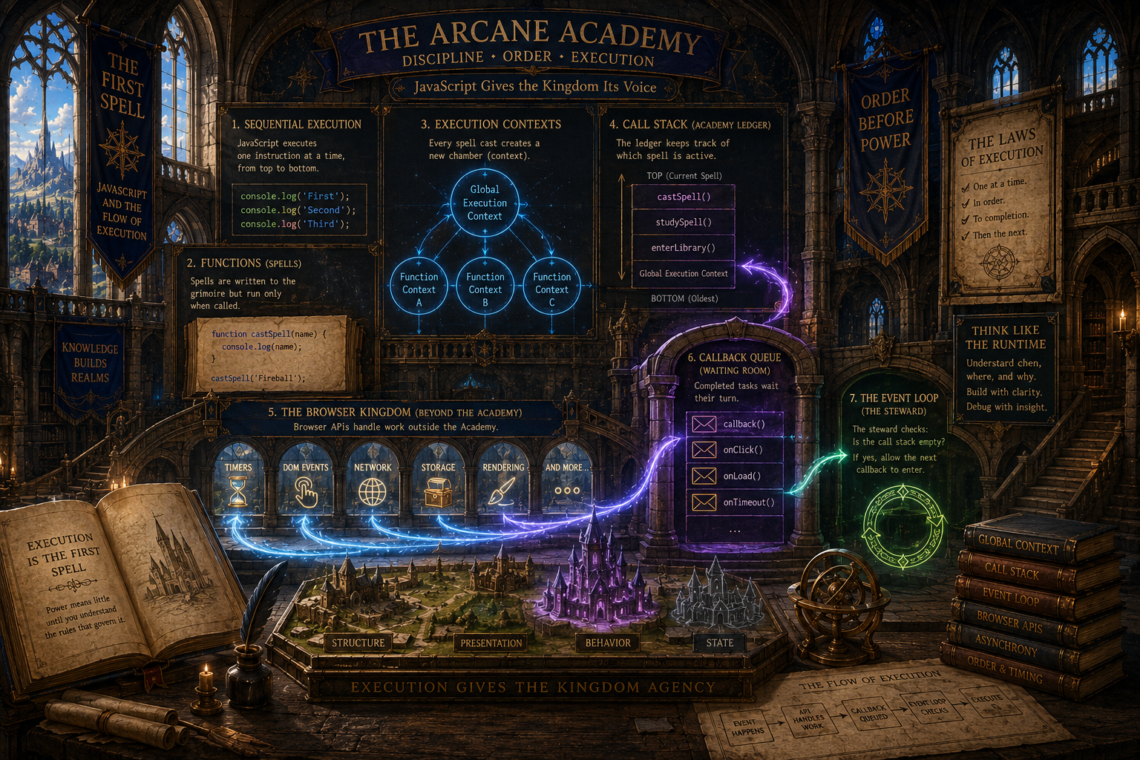
The First Spell: JavaScript and the Flow of Execution
The realm is built. Now it must respond to its heroes’ actions.
Editor’s Note
This article is an updated edition of an article originally published on RandomThoughtsInTraffic.com. For its StackNScroll.com edition, it has been substantially revised and expanded to shift the discussion from introductory JavaScript syntax toward the engineering principles that govern execution inside the browser. New material explores execution contexts, the Global Execution Context, the call stack, browser APIs, callback queues, and the event loop, and connects these concepts to the architecture of modern front-end applications. The objective of this edition is to help developing engineers build an accurate mental model of how JavaScript executes so that every framework, library, and application they encounter in the future rests upon a stronger engineering foundation.
The Spark of Adventure
During the first three chapters of our campaign, we transformed an empty wilderness into a thriving kingdom. We began by understanding how the browser surveys the landscape before constructing anything at all. We then laid enduring foundations with semantic HTML so every structure possessed both meaning and purpose. Finally, we forged armor through CSS, shaping the realm’s appearance without weakening the architecture beneath it. The kingdom became organized, attractive, and maintainable, but it still lacked something essential. It possessed architecture, but not agency. Roads that could not be traveled, gates that never opened, and merchants who never answered their customers created a convincing kingdom, but they could never become a living application.
That missing quality explains why HTML and CSS alone are never enough. They produce documents that can be explored, but not systems that can respond. A traveler may admire the castle walls, wander through the marketplace, or study the guild halls, yet the kingdom remains unchanged because of those actions. The gates never recognize an approaching visitor. The merchants never adjust their inventory after a purchase. The scholars inside the libraries never react to newly discovered knowledge. Everything appears complete, but nothing can respond to the people interacting with it.
This week’s theme, The Spark of Adventure, marks the moment our kingdom finally awakens. The tagline for this chapter captures that transition perfectly. The realm is built. Now it must respond to its heroes’ actions. Every successful web application eventually reaches this same milestone. Structure establishes the world. Presentation makes that world approachable. Behavior transforms that world into something interactive. JavaScript provides that behavior, but learning JavaScript has never really been about learning another programming language. It is about understanding the system that governs how behavior enters the browser.
When I first began learning JavaScript, I approached it the same way many developers do. I collected language features as though I were filling a spellbook. Variables became one spell. Loops became another. Functions, arrays, events, timers, and callbacks each occupied another page. My collection continued growing, and my applications gradually became more capable. Unfortunately, my understanding did not keep pace. Every so often, my code behaved in ways that appeared completely unreasonable, even though every line looked correct.
Looking back, the browser was never behaving irrationally. It was faithfully following its rules every single time. The real problem was my understanding of those rules. I knew individual spells, but I had never studied the principles that governed magic itself. That realization became one of the most important turning points in my development as a software engineer because it shifted my attention away from memorizing syntax and toward understanding how programs execute. Once I began following the browser rather than simply the code, JavaScript became dramatically easier to reason about.
Experienced engineers rarely think about JavaScript as a collection of isolated language features. Instead, they think about execution flow. They mentally follow the browser from one instruction to the next, understanding what information currently exists, which execution context is active, and what work has been scheduled for later. Debugging becomes less about experimenting until something works and more about reconstructing the path that produced the current state. That habit is one of the defining differences between writing code that merely functions and engineering systems that remain understandable years after they are built.
Our objective throughout this chapter is to begin developing that same mental model. By the end, I do not simply want you to recognize JavaScript syntax. I want you to understand why experienced developers organize behavior the way they do, why execution order matters more than many new engineers realize, and why every modern framework ultimately depends upon principles that have existed since JavaScript first entered the browser. Frameworks will continue evolving, but these underlying ideas remain remarkably stable because they describe how the browser itself operates.
The Arcane Academy
Every prosperous fantasy kingdom eventually establishes an academy devoted to the study of magic. Interestingly, those academies rarely begin by teaching spectacular spells. Instead, they teach discipline, consistency, and responsibility. Students first learn how magical energy behaves before attempting to control it. They discover that understanding the underlying laws of magic produces better results than simply memorizing increasingly powerful incantations. Software engineering follows a remarkably similar path.
JavaScript is frequently introduced as the language that makes web pages interactive. While that description is technically correct, it also understates the role JavaScript plays inside the browser. Interactivity is merely the visible outcome. Beneath that surface lies an execution engine responsible for processing instructions, creating execution contexts, managing memory, coordinating function calls, and communicating with surrounding browser systems. Once those responsibilities become clear, JavaScript stops feeling like a collection of unrelated features and begins resembling a carefully designed engineering system.
That perspective becomes increasingly valuable as applications grow larger. Small programs often succeed even when a developer has only a partial understanding of how they execute because there are relatively few moving parts. Enterprise applications tell a different story. Hundreds of modules, thousands of functions, asynchronous operations, user interactions, and remote services all work together within a single application. Engineers who understand execution continue building confidently because every new feature extends an existing mental model. Engineers relying primarily upon memorized syntax often find themselves surprised whenever the application grows beyond what they can comfortably visualize.
Early in my professional career, I slowly discovered that the browser almost never behaves unpredictably. It follows its rules with remarkable consistency. Whenever I believed JavaScript had become irrational, I eventually discovered that the browser had been executing my instructions exactly as written. My assumptions about timing, scope, or execution order had simply been incorrect. That realization changed the way I debugged software because it encouraged me to trust the runtime and question my own mental model instead.
The First Law of Arcane Engineering
Every engineering discipline rests upon a handful of principles so fundamental that nearly every advanced concept eventually traces back to them. Civil engineers rely upon structural loads. Electrical engineers rely upon predictable relationships between voltage, current, and resistance. Software engineers depend upon execution. Before we discuss asynchronous programming, browser events, or modern frameworks, we must first understand the simplest rule governing JavaScript.
Every JavaScript program begins inside what is known as the Global Execution Context. Think of it as the great hall of the Arcane Academy, where every lesson begins before students branch into smaller classrooms. From this initial context, JavaScript reads the script from top to bottom, creating additional execution contexts only when functions are invoked. Everything else we discuss in this article grows naturally from that foundation.
The browser executes synchronous JavaScript one instruction at a time.
That statement sounds almost too simple to deserve attention, yet it quietly governs everything that follows. Every variable assignment, function call, conditional statement, and loop participates in the same orderly progression. The browser begins executing at the top of the script, completes the current instruction, advances to the next, and continues until no synchronous work remains. Sophisticated applications do not replace this behavior. They build upon it.
This principle seems almost trivial until an application grows beyond a few hundred lines. At that point, developers begin discovering that understanding execution order is often more valuable than understanding individual language features. Variables rarely become mysterious on their own. They become mysterious because they are read before being assigned, modified later than expected, or accessed from the wrong execution context. Execution provides the timeline that explains all three situations, making it one of the most valuable concepts a software engineer can master.
Consider the following example.
</> JavaScript

console.log(`The apprentice enters the Arcane Academy.`);

let mana = 20;

console.log(`Current mana: ${mana}`);

mana = mana - 5;

console.log(`Remaining mana: ${mana}`);

console.log(`The lesson continues.`);
The arithmetic itself is not the lesson here. Neither are variables nor console statements. The engineering lesson is that every instruction depends upon the work completed before it. The second console statement cannot display a value that has not yet been assigned. Likewise, mana cannot be reduced until the variable already exists. Every line inherits the state produced by earlier instructions, creating a predictable execution path that remains remarkably consistent regardless of whether an application contains ten lines or ten thousand.
As I gained experience, I noticed that senior engineers tended to read code differently from beginners. New developers often jump directly to the line where something appears to have failed. Experienced developers usually begin much earlier. They ask where execution began, what values have already been established, which functions have already executed, and what assumptions the runtime has accepted before arriving at the current point. Those questions mirror the browser’s own execution model, making complex debugging sessions significantly more productive.
Initiative Governs Every Spell
One of my favorite Dungeons and Dragons mechanics is initiative because it provides an almost perfect analogy for JavaScript execution. Every participant eventually receives a turn, but nobody acts simultaneously. A powerful wizard cannot interrupt the fighter simply because the spell feels more important. Everyone waits for the proper moment, completes their actions, and yields control to the next participant. The system remains understandable precisely because every participant follows the same orderly sequence.
JavaScript follows an equally disciplined philosophy. Only one synchronous execution context occupies the top of the call stack at any given moment. Each instruction completes before the next begins, creating an execution flow that remains both predictable and observable. This does not prevent applications from becoming extraordinarily sophisticated. Instead, it ensures that even sophisticated applications remain understandable because they continue following consistent execution rules beneath their growing complexity.
Conditional logic illustrates this principle beautifully by introducing decision-making without sacrificing order.
</> JavaScript

let reputation = 12;

if (reputation >= 10) {
    console.log(`The city gates open.`);
} else {
    console.log(`The guards refuse entry.`);
}

console.log(`The journey continues.`);
Although two possible outcomes exist, only one branch executes during any particular run of the program. The browser evaluates the condition using the information currently available, executes the appropriate block, and immediately continues with the remaining instructions. The presence of choice does not introduce unpredictability. Instead, it demonstrates another important engineering lesson. Well-designed systems often appear simple because they continue to follow clear rules even as they make increasingly sophisticated decisions.
The Royal Spellbook
Once I became comfortable following JavaScript from one instruction to the next, another important realization began to take shape. Not every piece of code exists to execute immediately. Some behavior is defined long before it is ever needed, waiting patiently until the application reaches the appropriate moment. This is the true purpose of functions, and it is why reducing them to reusable blocks of code does not fully capture their value. Functions are organizational tools first, and language features second, because they allow engineers to separate capability from execution.
Within our growing kingdom, I think of functions as spells carefully recorded inside the archives of the Arcane Academy. Writing a spell into a grimoire changes nothing outside the library walls. The knowledge has been preserved, but the kingdom remains exactly as it was until someone deliberately invokes that spell. JavaScript behaves in precisely the same way. A function declaration stores behavior without executing it, separating preparation from action. That distinction becomes one of the most valuable engineering habits a developer can adopt because it encourages us to think about behavior as something we organize before we execute it.
Consider the following example.
</> JavaScript

function castSpell(spellName, manaCost) {
    let mana = 25;

    if (mana >= manaCost) {
        mana -= manaCost;

        console.log(`${spellName} succeeds.`);
        console.log(`Remaining mana: ${mana}`);
    } else {
        console.log(`${spellName} cannot be cast.`);
    }
}

castSpell(`Arcane Shield`, 8);
castSpell(`Meteor Storm`, 30);
The engineering lesson is not simply that the function can be reused. The more important observation is that the browser encounters the function declaration long before it encounters either function call. During execution, JavaScript records the function so it can be invoked later, but none of the statements inside the function execute until the browser reaches the calls at the bottom of the script. Understanding that distinction changes how we organize applications by separating capability from activity. Mature software is filled with behavior that remains dormant until the appropriate moment arrives.
As projects continue to grow, this distinction begins to influence architecture as much as implementation. Instead of constructing a single enormous script that performs every task sequentially, we begin by organizing behavior into focused units with clear responsibilities. Each function becomes responsible for solving one problem well, making the overall application easier to understand and significantly easier to maintain. When another engineer joins the project months later, they should be able to understand each function independently without first tracing an entire application from beginning to end. That clarity is one of the hallmarks of professional software engineering.
Every Spell Has Its Own Chamber
Preparing a spell introduces another concept that quietly supports nearly every modern JavaScript application. Whenever a function executes, JavaScript creates a new execution context dedicated to that invocation. I like to imagine each execution context as a private chamber inside the Arcane Academy where one spell is prepared independently from every other spell. Whatever happens inside that chamber remains isolated unless information is intentionally carried back into the rest of the kingdom.
This isolation exists for good reason. Imagine attempting to manage an academy where every apprentice shares the same desk, the same notes, and the same collection of magical ingredients. Chaos would quickly replace order because every student’s work would interfere with everyone else’s. JavaScript avoids exactly that problem by giving every function call its own local environment. Variables declared inside a function belong only to that execution context unless they are deliberately returned or exposed in another way.
The following example demonstrates this separation.
</> JavaScript

function preparePotion() {
    let ingredient = `Moonflower`;

    console.log(`Using ${ingredient}.`);
}

preparePotion();

console.log(ingredient);
The final statement produces an error because ingredient exists only inside the execution context created for preparePotion(). Once the function completes, that local variable is no longer available to the surrounding code. Rather than viewing this limitation as inconvenient, experienced engineers recognize it as one of JavaScript’s greatest strengths. Local scope protects functions from accidentally changing information they should never have been able to reach in the first place.
Execution contexts also provide another important benefit. They allow multiple invocations of the same function to execute independently without interfering with one another. Each invocation receives its own variables, parameters, and temporary data, making every function call a self-contained unit of work. This consistency allows developers to reason about behavior one execution context at a time instead of attempting to mentally manage the entire application at once.
As applications become larger and more collaborative, execution contexts become even more valuable. Hundreds of functions may execute throughout the lifetime of an application, each creating temporary variables as it performs its own responsibilities. Because every execution context remains isolated, developers can reason about one function without constantly worrying that unrelated code somewhere else has quietly modified its internal state. That isolation is one of the reasons modern software can continue scaling long after individual source files become too large for any one person to memorize.
The Academy Ledger
Creating separate execution contexts immediately raises another question. If multiple functions call one another, how does the browser remember which one should continue executing after the current function finishes? JavaScript answers that question through a structure known as the call stack. Although the name sounds intimidating, the underlying idea is remarkably straightforward.
Inside our Arcane Academy, I picture the call stack as the master ledger maintained by the academy’s archivists. Whenever a mage begins casting a spell, that spell is entered into the ledger. If another spell must be performed before the first one can finish, the new entry is added above the existing one. When the current spell completes, the archivists remove it from the ledger and resume the previous unfinished task. The ledger always reveals exactly which spell is currently active and which work remains waiting beneath it.
The browser follows precisely the same pattern.
</> JavaScript

function enterLibrary() {
    studySpell();
}

function studySpell() {
    castSpell();
}

function castSpell() {
    console.log(`The spell succeeds.`);
}

enterLibrary();
Execution begins within the Global Execution Context. When enterLibrary() executes, JavaScript creates a new execution context and places it on top of the call stack. Before that function finishes, it invokes studySpell(), creating another execution context above the first. studySpell() then calls castSpell(), placing a third execution context at the top of the stack. As each function completes, its execution context is removed, allowing execution to resume exactly where it left off inside the previous function. This process continues until every function has completed and the call stack once again contains only the Global Execution Context.
Understanding the call stack fundamentally changes the way developers interpret stack traces during debugging. Rather than seeing an intimidating list of function names, experienced engineers recognize the exact path the browser followed to reach the current point. Each line represents another step through the application’s execution history. Instead of wondering how a particular function was reached, they simply read the stack from top to bottom, reconstructing the browser’s journey through the application one execution context at a time. Once you begin visualizing the call stack in your mind, many debugging sessions become significantly shorter because the browser’s behavior suddenly becomes much easier to explain.
When the Kingdom Begins Listening
Everything we have examined so far follows a straightforward pattern. The browser begins executing JavaScript, processes one instruction after another, and eventually reaches the end of the script. If web applications behaved only this way, they would still resemble interactive documents rather than living systems. Fortunately, browsers were designed to support something much richer.
A completed kingdom spends very little time actively changing itself. Most of the time, it waits. Travelers approach the city gates. Merchants greet customers entering the marketplace. Messengers deliver news from distant provinces. Scholars discover forgotten knowledge within the academy. The kingdom reacts when someone initiates an action. Modern web applications behave exactly the same way. Instead of constantly executing code, they patiently wait for meaningful events generated by the people using them.
This shift represents one of the most significant conceptual changes in front-end development. We are no longer writing programs that simply perform work from beginning to end. We are building systems that respond whenever meaningful events occur. The browser becomes an attentive steward, observing everything that happens within the page and notifying JavaScript whenever action is required.
</> JavaScript

const button = document.querySelector(`#castSpell`);

button.addEventListener(`click`, function () {
    console.log(`The spell has been cast.`);
});
Notice what the browser actually does when it encounters this code. It does not execute the callback function immediately. Instead, it registers that function as the appropriate response should a click occur later. JavaScript then continues executing the remainder of the current script. Whether the user clicks the button two seconds later or two hours later makes no difference. When the event finally occurs, the browser already knows which behavior should enter the execution flow.
This is the moment where our kingdom truly gains agency. Roads are no longer merely decorative. Gates no longer stand permanently open or permanently closed. Merchants can respond to customers. Scholars can react to new discoveries. The world has begun responding to its inhabitants, and every interaction creates another opportunity for JavaScript to participate.
The Royal Courier
Early in my career, I assumed JavaScript somehow paused whenever it encountered a timer or began waiting for user interaction. That assumption seemed reasonable because delayed work appeared later on the screen. Eventually, I realized the browser was doing something much more sophisticated. Rather than stopping execution, it continued processing all currently available synchronous instructions while delegating other responsibilities to specialized browser systems.
Timers provide an excellent example of this cooperation. When JavaScript encounters a timer, it asks the browser to monitor the passage of time. The browser accepts that responsibility, allowing JavaScript to continue executing the remaining synchronous code. Network requests, rendering updates, user interactions, and countless other browser services follow the same general pattern. JavaScript delegates work to the browser, which manages it independently until the appropriate moment for JavaScript to resume processing.
The relationship between JavaScript and the browser explains why modern applications appear capable of doing many things simultaneously, even though the JavaScript engine continues executing one synchronous task at a time. The browser coordinates rendering, timers, networking, accessibility, and user input, while JavaScript focuses on the work currently on the call stack. Understanding that partnership prepares us for the final piece of our execution model, where browser APIs, callback queues, and the event loop cooperate to determine exactly when delayed work is allowed to return to the JavaScript engine.
The Steward of the Academy
At this point, we have examined sequential execution, execution contexts, the call stack, and the browser’s role in observing events and timers. The final piece of the puzzle is understanding how delayed work eventually returns to JavaScript after the browser has finished managing it. This is where many developers first encounter terms such as callback queue and event loop. Those names often sound far more intimidating than the concepts they represent.
The important lesson is that JavaScript never abandons its orderly execution model simply because asynchronous work exists. Instead, the browser carefully coordinates delayed operations until JavaScript is ready to process them. When a timer expires, a network request completes, or a user clicks a button, the associated callback does not immediately interrupt the current execution. Instead, it waits patiently until the call stack becomes empty. Only then is that callback allowed to enter the execution flow and begin executing like any other function.
The browser coordinates this process through browser APIs, callback queues, and the event loop. Browser APIs perform the requested work outside the JavaScript engine, while completed callbacks wait inside the callback queue. Once the call stack is empty, the event loop checks the queue and executes the next waiting callback. Although each of these mechanisms deserves its own detailed discussion, understanding their relationship is sufficient to explain why asynchronous code behaves as it does. Rather than replacing JavaScript’s orderly execution model, these systems preserve it.
Within our kingdom, I imagine this responsibility belonging to the Steward of the Academy. The steward watches the roads, the messenger towers, the city gates, and every magical courier arriving from across the realm. The scholars inside the academy remain focused on the lesson currently before them. Whenever new work arrives, the steward determines when it may enter the academy. The scholars never abandon the lesson already in progress. They complete the current work before welcoming the next visitor through the doors.
That distinction explains why asynchronous code often surprises developers during their first encounters with timers.
</> JavaScript

console.log(`Preparing spell.`);

setTimeout(function () {
    console.log(`Spell effect appears.`);
}, 2000);

console.log(`Preparing next action.`);
Many developers initially expect the delayed message to appear before the final console statement because the timer appears earlier in the source code. The browser follows a different sequence. It registers the timer with its timing system, continues executing the remaining synchronous statements, and only returns to the callback after the delay has expired, the callback has entered the callback queue, and the call stack has become available. Nothing has happened out of order. The browser has simply continued following a broader execution model than many beginning developers realize exists.
Understanding this behavior completely changed the way I approached asynchronous programming. Instead of imagining delayed operations as interruptions, I began thinking of them as scheduled work patiently waiting for their turn. That mental model aligns far more closely with how the browser actually operates, making asynchronous behavior significantly easier to reason about as applications become larger and more interactive.
When Timing Becomes the Real Bug
Over time, I noticed that many JavaScript bugs were not caused by incorrect syntax or flawed algorithms. Instead, they resulted from incorrect assumptions about when information would become available. Developers frequently write perfectly valid code that executes at the wrong moment. Because the syntax appears correct, the resulting behavior feels confusing until the execution flow is examined more carefully.
Consider the following example.
</> JaveScript

let treasure;

setTimeout(function () {
    treasure = `Ancient Relic`;
}, 1000);

console.log(treasure);
Many new developers expect the console to display Ancient Relic. Instead, it displays undefined. The browser has done exactly what it was instructed to do. The timer was registered, the final console statement executed immediately, and only afterward did the callback assign a value to the variable. The issue has nothing to do with variables, timers, or syntax. The problem is entirely one of execution order.
The simplest correction is to move the work to the point where the information actually exists.
JavaScript

setTimeout(function () {
    const treasure = `Ancient Relic`;

    console.log(treasure);
}, 1000);
Although this example is intentionally small, the underlying lesson scales remarkably well. Production applications continuously coordinate information arriving from databases, authentication providers, remote APIs, browser services, and user interactions. Rarely do those systems fail because JavaScript cannot handle them. More often, they fail because developers misunderstand when particular pieces of information become available. Experienced engineers, therefore, spend considerable time reasoning about execution before attempting to solve implementation details. Learning to ask when a value becomes available often resolves bugs more quickly than asking why the value appears incorrect.
Thinking Like the Archmage
Early in my career, I spent far too much energy memorizing JavaScript features. Every new language construct felt like another tool to add to an ever-growing collection. That knowledge certainly had value, but it never explained why experienced developers seemed able to solve difficult debugging problems so quickly. The difference was not that they remembered more syntax. The difference was that they had learned to think like the runtime itself.
Thinking like the runtime means mentally following execution exactly as the browser follows it. Rather than asking what a function is supposed to accomplish, experienced engineers ask when it executes, which execution context currently exists, what information has already been established, and which browser systems may still be performing work independently. Those questions naturally produce better software because they encourage developers to design around predictable execution rather than optimistic assumptions.
Over time, this way of thinking begins influencing architectural decisions just as much as implementation details. Developers who understand execution flow naturally write smaller, more focused functions because execution paths remain easier to visualize. They separate responsibilities between data retrieval, business logic, and presentation because each responsibility occupies a different place within the application’s execution model. They rely upon browser events rather than continuously checking for changes because the browser already provides an efficient mechanism for communicating meaningful activity. None of these habits emerges because a style guide demands them. They emerge because the execution model naturally encourages them.
Perhaps most importantly, this perspective transfers directly into every modern framework. React, Vue, Angular, Svelte, and countless others introduce their own abstractions, but none of them replace the browser’s execution model. Components still execute JavaScript. Event handlers still rely upon the call stack. Browser APIs still coordinate asynchronous work. Engineers who understand these underlying principles usually adapt to new frameworks quickly because they recognize familiar behavior beneath unfamiliar syntax.
The Kingdom Has Found Its Voice
Throughout this article, I have referred to JavaScript as the kingdom’s first spell. Looking back, I think that description is incomplete. A spell suggests power, but execution provides something even more valuable. It provides intention. A kingdom filled with powerful magic but governed by inconsistent rules quickly descends into chaos. A kingdom governed by predictable laws allows every citizen to understand what happens next. The browser rewards software built with exactly that same discipline.
Looking back across the first four chapters of The Full-Stack Campaign, the progression should now feel deliberate rather than accidental. In Part I, we learned how the browser surveys and constructs the world before rendering it. Part II established meaningful structure through semantic HTML. Part III forged CSS into the armor that organizes and protects the kingdom’s visual presentation. This chapter completes the next stage of that journey by introducing the first true source of agency. Construction and execution are different responsibilities, yet every modern application depends equally upon both.
The Arcane Academy now occupies a permanent place within the kingdom we have been building together. It represents more than JavaScript itself. It represents disciplined execution, thoughtful organization, and the understanding that power without structure inevitably becomes chaos. Every spell recorded within its halls follows predictable rules before influencing the world beyond its walls. Likewise, every line of JavaScript follows a consistent execution model before affecting the applications we build.
This is why I consider execution flow one of the most important concepts a developer can learn early in a career. Features will change. Frameworks will evolve. Best practices will continue maturing alongside the web platform itself. The browser’s execution model, however, remains one of the enduring foundations upon which those innovations are built. Understanding that foundation allows engineers to evaluate new technologies with confidence because they recognize the familiar principles operating beneath every abstraction.
Preparing the Royal Inventory
Our campaign now reaches another natural turning point. Throughout this chapter, we have concentrated on when behavior occurs. Execution flow, execution contexts, the Global Execution Context, the call stack, browser APIs, callback queues, and the event loop all exist to answer that question. Another equally important question now begins demanding our attention.
What should the application remember after each action has finished?
Execution determines when change occurs. State determines whether that change survives beyond the current execution. Without execution, there is no interaction. Without state, every interaction is immediately forgotten. Professional software engineering requires both because applications must not only respond to their users but also remember those responses. The two concepts reinforce one another, and understanding one without the other leaves an important gap in our engineering foundation.
Wednesday’s article, The Inventory System: Managing State Without Losing Control, continues our campaign by exploring how applications preserve information as users interact with the world we have now brought to life. Every spell cast within our kingdom changes something, whether that change affects mana, inventory, navigation, or application data. The kingdom has begun responding to its heroes. Our next responsibility is ensuring that it remembers those responses accurately and consistently as the adventure continues.
The first spell was never about learning another programming language. It was about learning to think the way the browser thinks. Experienced engineers eventually stop asking only what their code should do and begin asking what the runtime is doing at every moment. That change in perspective quietly transforms debugging, architecture, and design because every engineering decision rests upon an accurate understanding of execution. It is a lesson that extends far beyond JavaScript and will continue to guide us as our kingdom grows more capable throughout the rest of The Full-Stack Campaign.


You May Also Like

From Interface to Infrastructure

Armor and Appearance: CSS Layout Without Chaos