-
The Dragon Named Scale: Building Systems That Grow
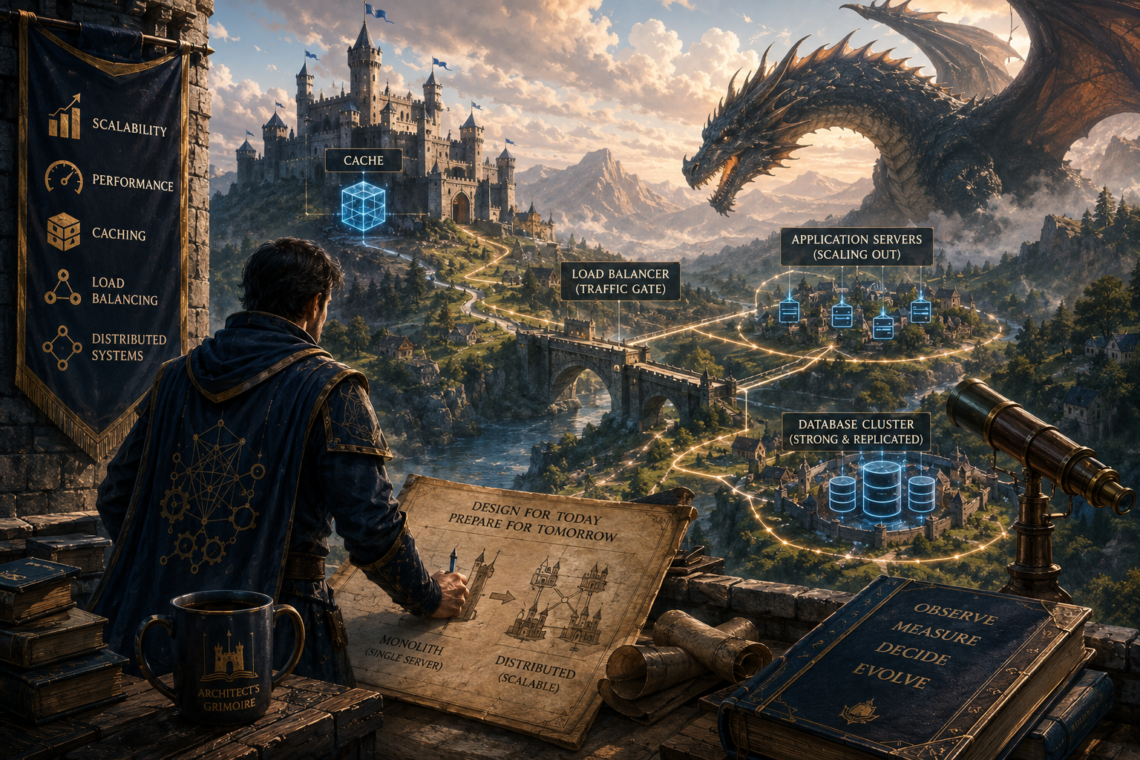
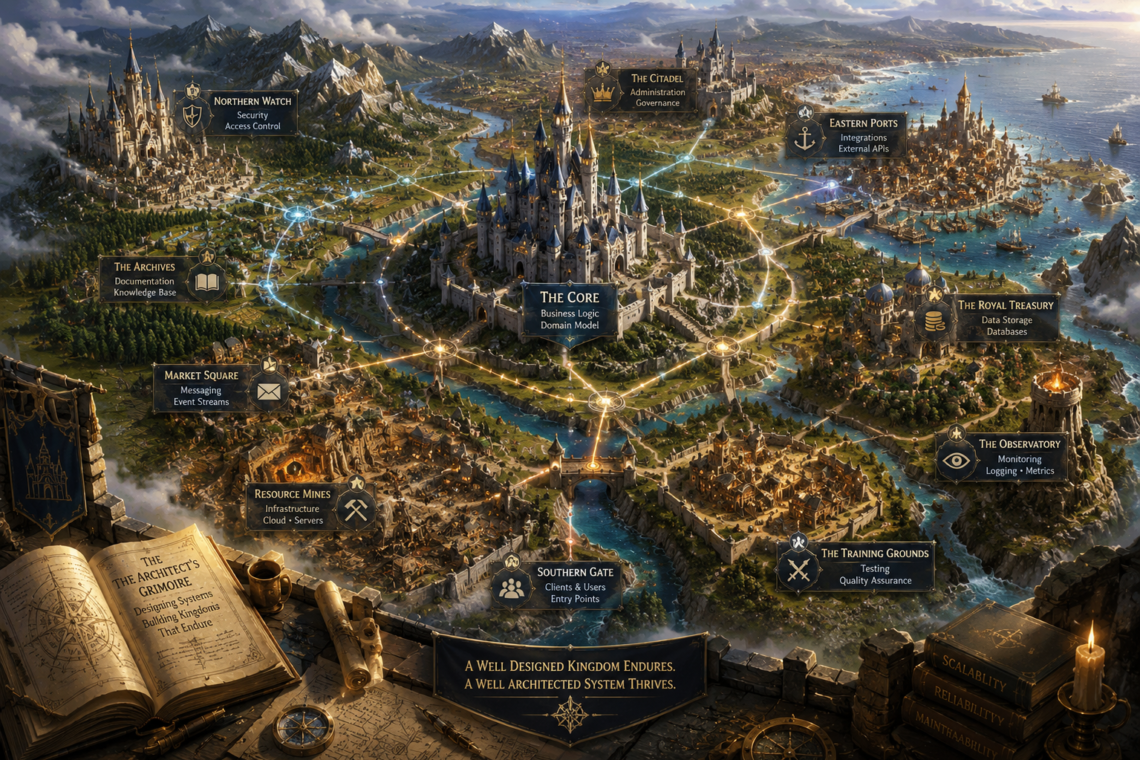
The Dragon Named Scale: Building Systems That Grow Every growing kingdom eventually attracts dragons. Success changes software in ways that are easy to underestimate. The application that comfortably serves a handful of users suddenly supports thousands. Database queries that once completed in milliseconds begin competing for resources. Features that once lived peacefully beside one another begin interacting in unexpected ways. None of these changes necessarily mean the original architecture was flawed. They simply reflect a reality every successful system eventually encounters. Growth exposes assumptions that remained invisible while the kingdom was still small. The fantasy kingdoms that have accompanied us throughout The Architect’s Grimoire offer another lesson worth carrying into…
-
The Royal Treasury: Protecting the Kingdom’s Data
The kingdom’s greatest treasure is not its gold, but who guards it. Every successful software system eventually becomes responsible for something far more valuable than the application itself. During its earliest days, a project may consist of little more than a handful of pages, a modest database, and enough business logic to solve a single problem. As the software matures, however, customers begin entrusting it with personal information, financial transactions, authentication credentials, business records, intellectual property, and years of institutional knowledge. Without anyone announcing the moment it happens, the application becomes the keeper of a treasury whose value far exceeds the cost of constructing the software. Many developers begin their…
-
Dividing the Kingdom: Finding the Right Boundaries
A realm divided too soon may fall before it ever grows. Software architecture has a way of making every difficult decision appear deceptively simple. A whiteboard fills with neatly drawn boxes connected by clean lines, and suddenly an application that once fit comfortably into a single project has become a collection of independent services. Every box promises greater flexibility, cleaner organization, and limitless room for future growth. Years spent designing, maintaining, and repairing production systems eventually teach every architect the same lesson. Every boundary carries a cost that will be paid long after the diagram has been erased. This week, as we continue Designing the Realm, we are moving beyond…
-
The Curse of Premature Fortification
Not every empty field needs a fortress. Software rarely becomes difficult to maintain because developers lacked technical ability. More often, intelligent engineers create long-term maintenance problems by solving challenges that have not yet appeared. A project begins with a handful of straightforward requirements, but its structure quickly expands to accommodate hypothetical integrations, future scalability, interchangeable components, and extension points that may never become necessary. Before long, the codebase grows steadily larger while the problem it exists to solve remains remarkably small. Long before the application reaches maturity, supporting the design requires nearly as much effort as advancing the product itself. Good design prepares software to evolve as knowledge grows. Premature…
-
Building for Today’s Quest or Tomorrow’s Empire?
Every shortcut is a promise the future must eventually keep. The First Road Beyond the Castle Gates Long before a kingdom becomes an empire, someone chooses where the first road will be built. Travelers may never remember who laid those stones, but generations will depend upon the decision. Software is built much the same way. Long before users celebrate new features, someone quietly decides how the application will grow, how its parts will work together, and whether future engineers will inherit a thriving kingdom or spend their days repairing crumbling foundations. When I first began writing software, I believed every project had a finish line. Complete the feature, fix the…
-
Building Kingdoms That Endure
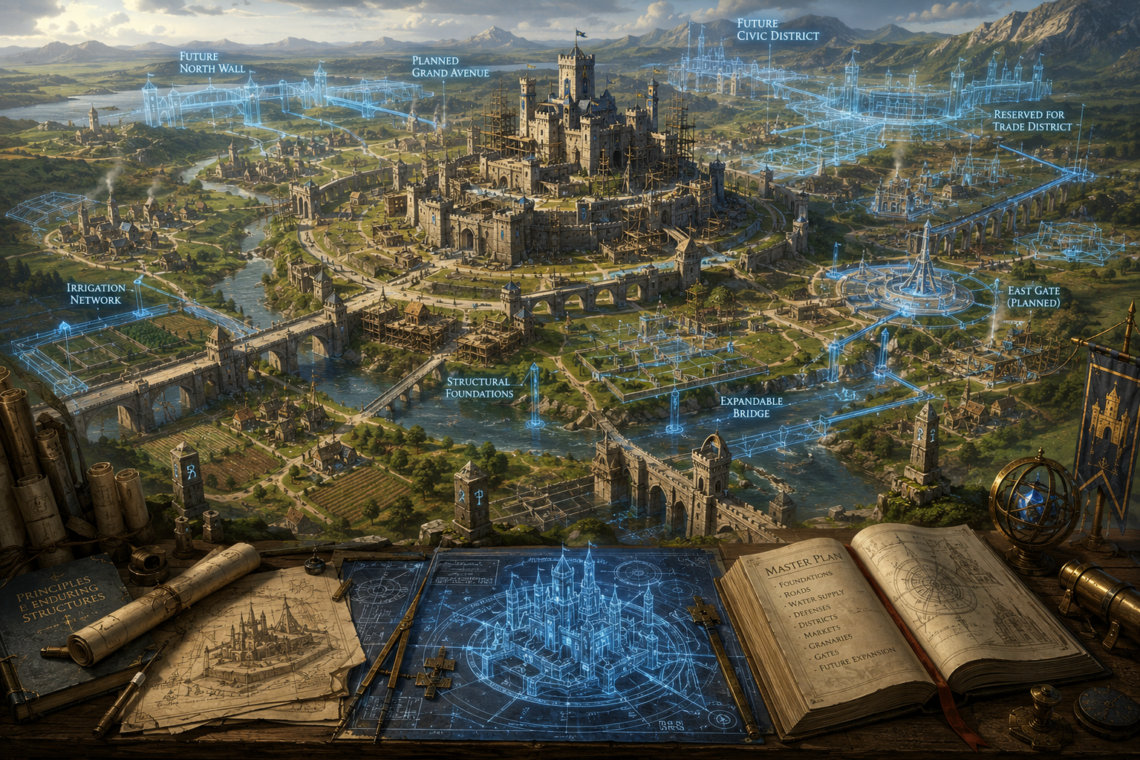
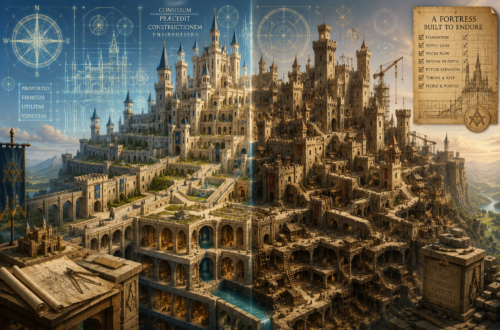
Every enduring kingdom begins with a blueprint. Every developer learns to build. The best developers learn what to build next. No kingdom becomes legendary because its masons laid beautiful stones. No empire survives because its carpenters built magnificent gates or its blacksmiths forged exceptional swords. History remembers kingdoms that endured because someone looked beyond the next building and imagined how an entire realm would one day function. Roads connected cities before merchants ever traveled them. Walls protected districts that had not yet been built. Aqueducts carried water to neighborhoods that existed only on parchment. Long before the first stone was laid, someone had already begun designing the future. Software follows…
-
Building a Portfolio Worth Showing
Good work deserves witnesses. Build proof of the journey, not merely trophies. Every Adventurer Needs a Record of Their Journey One of the most common mistakes I see newer developers make is treating a portfolio as something they will build someday. They imagine a future version of themselves who has completed enough projects, learned enough technologies, and accumulated enough experience to finally deserve a public showcase. Until that day arrives, they keep their work hidden inside repositories, forgotten folders, abandoned cloud accounts, and unfinished side projects. Unfortunately, that approach creates a serious problem. By the time they decide they need a portfolio, much of the journey that would have made…
-
Legacy Code and Ancient Curses
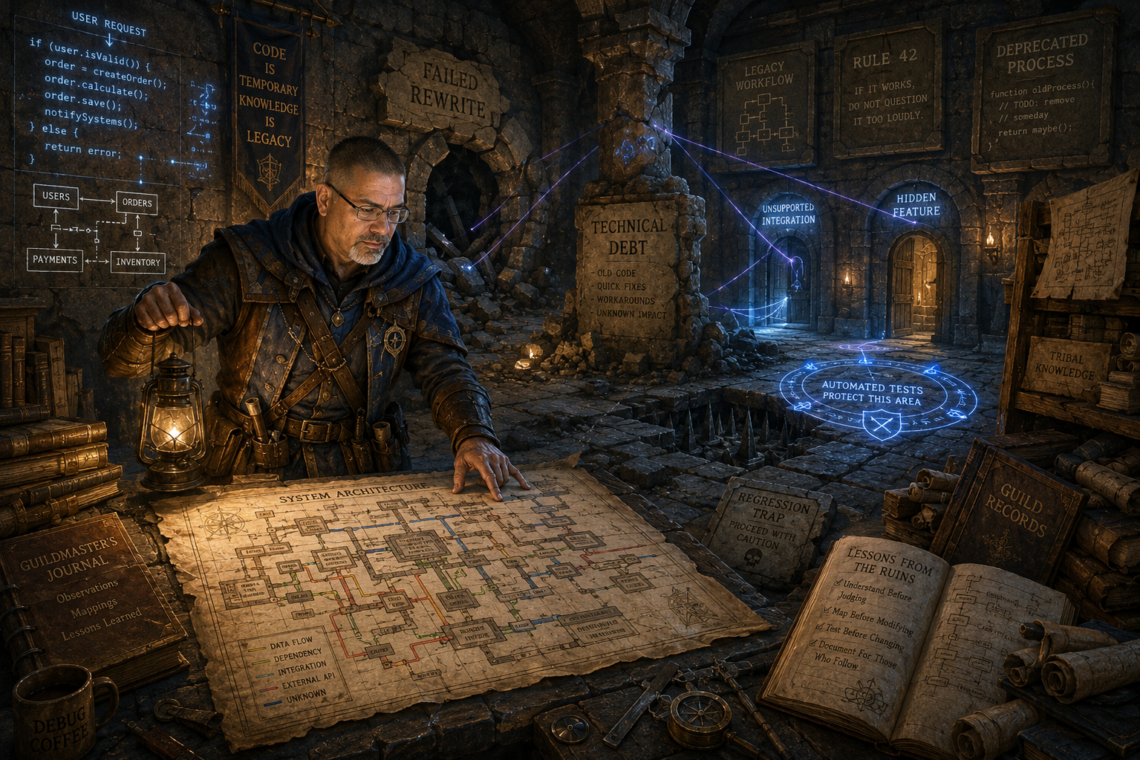
Every developer eventually enters forgotten ruins and wonders what kind of sorcery built them. Entering the Forgotten Ruins Among all the challenges software engineers face throughout their careers, few are as universal as inheriting legacy code. Most developers begin their journey imagining they will spend their days creating new applications, experimenting with modern technologies, and designing elegant architectures from a blank canvas. While those opportunities certainly exist, they represent only a portion of professional software development. Much of our work involves maintaining, extending, repairing, and modernizing systems that already exist. Some of these applications are only a few years old. Others have survived multiple generations of developers and business leaders.…
-
Working With Stakeholders Without Losing Sanity
The kingdom rarely speaks in technical terms. Wisdom begins with learning how to translate chaos. The Most Important Room Most Engineers Underestimate When many people first enter the world of software development, they imagine that success will be determined primarily by technical skill. They expect to spend their days solving complex problems, learning new technologies, designing elegant systems, and building useful applications. Those activities certainly form an important part of the profession, but they are not the whole story. Over time, most engineers discover that some of the most challenging and valuable work they perform happens away from the keyboard. I learned this lesson slowly. Early in my career, I…
-
Building Skills That Actually Matter
The realm rewards more than talent. Learn the skills that survive beyond tutorials and trends. When new adventurers first enter a guild hall, they tend to focus on the same question. Which class should I choose? Some are drawn to warriors because they appear dependable and powerful. Others are fascinated by wizards because of the possibilities that magic provides. Rangers, rogues, clerics, and bards all offer their own attractions. New developers often approach technology in exactly the same way. They ask whether they should become frontend developers, backend engineers, cybersecurity specialists, cloud architects, or data professionals. While the question is understandable, I have learned over the years that it is…