From Interface to Infrastructure
Before adventurers can explore the world, they must understand the rules that shape it.
Editor’s Note
Before appearing as the opening chapter of The Full-Stack Campaign: From Interface to Infrastructure, this article first appeared on RandomThoughtsInTraffic.com as an exploration of why developers often struggle when their knowledge remains confined to a single layer of the technology stack. This revised and expanded edition examines how information travels through modern web applications, explores the relationships between browsers, APIs, servers, databases, and infrastructure, and establishes the systems-oriented mindset that guides the remainder of the series. New material includes expanded architectural examples, a deeper discussion of specialization within software development, and a practical examination of how seemingly independent technologies depend upon one another. While the original article encouraged developers to look beyond their immediate area of expertise, this edition provides a more comprehensive framework for understanding how modern applications function as interconnected systems.
The Cartographer’s Mistake
Long before an adventurer sets foot on a road, they study a map. Maps provide structure to an unfamiliar world. They identify roads, reveal major landmarks, and establish relationships between distant regions. Without them, travelers are forced to rely entirely upon instinct, rumor, and luck. Yet experienced adventurers understand a lesson that newcomers often overlook. A map is not the territory itself. It is a simplified representation designed to make a complicated reality easier to understand. The terrain always contains details, obstacles, dependencies, and opportunities that cannot be fully captured by ink on parchment.
The way web development is taught often follows a similar pattern. HTML becomes one lesson. CSS becomes another. JavaScript is introduced separately. APIs, databases, deployment pipelines, cloud platforms, and infrastructure are often treated as distinct disciplines with their own tutorials, courses, and learning paths. This approach makes perfect sense from an educational perspective because large topics are easier to absorb when divided into smaller pieces. The problem emerges later when developers discover that real applications do not respect the boundaries established by those lessons.
Most educational content is intentionally narrow in scope. A lesson about Flexbox does not need to discuss SQL. A database tutorial rarely explores browser rendering. A JavaScript course often ignores deployment entirely. Each lesson provides valuable knowledge, but the separation can unintentionally create a distorted view of how applications actually work. Developers learn individual technologies while receiving relatively little guidance regarding the relationships between them.
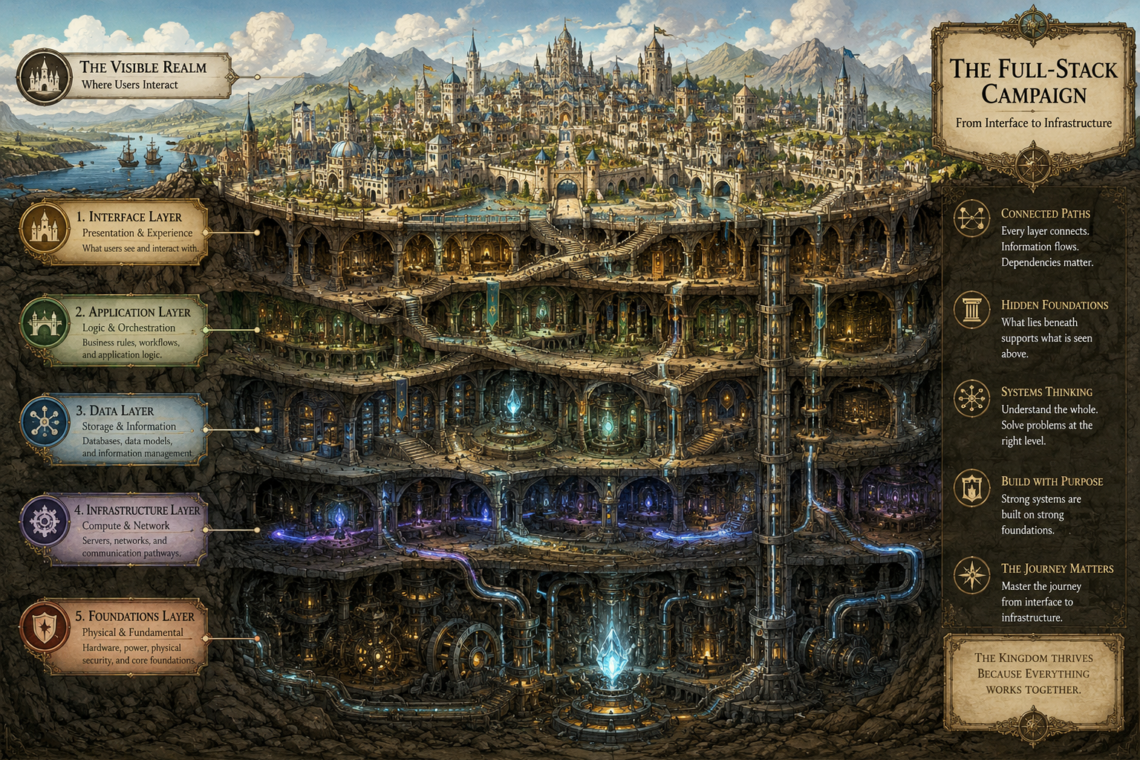
This becomes particularly noticeable when developers begin building software that serves real users. Applications are not collections of isolated technologies. They are systems. Every visible feature depends upon multiple layers working together toward a common objective. The interface depends upon data. Data depends upon storage. Storage depends upon infrastructure. Infrastructure depends upon deployment and configuration. The individual pieces matter, but the relationships between them often determine whether a system succeeds or fails.
A common misconception among newer developers is that technical growth primarily involves accumulating additional technologies. Learn another framework. Learn another language. Learn another cloud platform. There is certainly value in expanding technical knowledge, but many developers eventually discover that the greatest challenges rarely come from individual tools. They come from understanding how those tools interact and how information moves between them.
Consider something as simple as displaying a list of products on an online store. To the user, the feature appears straightforward. Products appear on a page. Images load. Prices are displayed. Inventory information is visible. The entire experience feels immediate and self-contained. Behind the scenes, however, an enormous amount of coordination has taken place. Data has moved through networks, APIs, application servers, databases, business rules, and rendering engines before finally reaching the browser. What appears to be a simple page to the user is, from the system’s perspective, a journey through multiple interconnected layers that must all function correctly.
That distinction is important because software problems frequently emerge during the journey rather than at the destination. A page may load slowly because of a database query. A feature may become difficult to build because of API design decisions. A deployment issue may reveal assumptions embedded deep within application code. Problems often appear in one location while originating somewhere entirely different.
Throughout my career, the most effective engineers I have worked with understood this reality exceptionally well. Some specialized in front-end architecture. Others focused primarily on databases, infrastructure, or server-side systems. What separated them from their peers was not necessarily the depth of their specialization. It was their ability to understand how their area of expertise connected to the rest of the application. They could follow information as it moved through the system. They understood where responsibilities began, where they ended, and how decisions made in one layer affected everything around it.
This observation forms the foundation of the Full-Stack Campaign. The objective is not to transform every reader into an expert in every technology. Such a goal would be unrealistic and unnecessary. The objective is to develop a mental model that explains how modern web applications function as complete systems. Before adventurers can navigate a realm successfully, they must first understand how its roads, rivers, borders, and kingdoms connect.
Roads Between Kingdoms
The prosperity of a kingdom depends as much on its connections as its landmarks. Travelers admire castles, marketplaces, guild halls, and city walls because those structures dominate the landscape. They are visible reminders of a kingdom’s success. Far less attention is given to the roads connecting those cities, the bridges spanning rivers, the supply routes supporting commerce, and the messengers carrying information throughout the realm. Yet remove those connections and even the strongest kingdom begins to weaken.
Modern web applications operate according to the same principle. Most users interact exclusively with interfaces. They click buttons, submit forms, browse products, view reports, and navigate pages. Everything beyond the interface remains hidden. Developers often begin their careers with a similar perspective because interfaces provide immediate feedback. A layout changes. A button responds. A feature appears. Progress feels tangible because results are visible.
The visible portions of an application tell only part of the story. Consider a customer browsing an online store. The customer clicks a category, searches for products, and reviews the results displayed on the page. From the user’s perspective, the process appears nearly instantaneous. What the user does not see is the chain of events occurring behind the scenes. Information travels across multiple systems before those results ever appear in the browser.
A simplified version of that journey begins with JavaScript requesting information from an API:
</> JavaScript

async function getProducts() {
    const response = await fetch('/api/products');
    const products = await response.json();

    displayProducts(products);
}
At first glance, the code appears straightforward. A request is sent. Data is returned. Products are displayed. Many developers stop their analysis at this point because the feature appears to be functioning correctly. The reality is that this small block of code represents only the beginning of a much larger story.
To understand the system, we must follow the request beyond the city gates. The browser sends a request to an API endpoint. That endpoint exists because the browser should not communicate directly with the database. Instead, the request is routed to a service responsible for validating inputs, enforcing business rules, and determining which information should be returned. The API serves as a contract between the interface and the systems that support it. The browser asks for information in a specific format, and the server responds according to agreed-upon rules.
A simplified server endpoint might look like this:
</> JavaScript

app.get('/api/products', async (req, res) => {
    const products = await Product.findAll();

    res.json(products);
});
This code appears nearly as simple as the browser example. A request arrives, products are retrieved, and a response is returned. Yet important details remain hidden beneath the surface. The server depends upon a functioning database connection. It may enforce security policies, validate permissions, apply filtering rules, record audit logs, transform data structures, and handle unexpected failures. The endpoint itself represents only one stage in a much larger process.
The request eventually reaches the database, where information must be stored, organized, and retrieved efficiently.
</> SQL

SELECT
    product_id,
    product_name,
    price,
    inventory_count
FROM products
WHERE active = true
ORDER BY product_name;
Viewed independently, none of these examples appear particularly complicated. A browser request. A server endpoint. A database query. Most educational resources teach these subjects separately because doing so makes learning manageable. The challenge is that users never experience them separately. Every interaction depends upon all of them functioning together successfully.
This reality becomes easier to appreciate when something goes wrong. Imagine customers begin reporting that product searches take several seconds to complete. The front-end team may initially investigate browser rendering performance. The back-end team may review API response times. Database administrators may examine execution plans and indexing strategies. Infrastructure engineers may inspect network latency and server resource utilization. Each group begins by examining the portion of the system they understand best.
The actual problem, however, may not reside within any one layer. A poorly designed database query might increase API response times. Slow API responses may leave the browser waiting for data. The browser may appear sluggish even though its code is functioning correctly. Users experience a slow page, but the root cause exists several layers away from the symptoms. Developers who understand only one layer often spend considerable time investigating the wrong part of the system.
This is one reason systems thinking becomes increasingly valuable as applications grow. A developer who understands the complete request lifecycle can follow information as it moves through the application. They recognize that symptoms and causes do not always appear in the same place. Instead of focusing exclusively on the visible result, they examine the entire journey. That broader perspective often leads to faster diagnosis, better communication, and more effective solutions.
Understanding the journey also changes how developers evaluate architectural decisions. A seemingly harmless change to a database schema may influence API performance. An API redesign may simplify server implementation while creating significant work for front-end developers. Infrastructure decisions may affect how applications are deployed, monitored, and maintained. Every layer contributes to the overall experience because every layer participates in the movement of information.
The deeper lesson is that software development is fundamentally concerned with communication. Interfaces communicate with users. APIs communicate between services. Databases communicate information across time. Monitoring systems communicate operational health. Every major component exists to either produce, transform, transport, or store information. Once developers begin viewing applications through this lens, the purpose of individual technologies becomes much easier to understand because they are seen as participants in a larger system rather than isolated tools.
When the Guilds Stop Talking
One of the most instructive failures I have witnessed throughout my career had nothing to do with programming languages, frameworks, databases, or cloud platforms. The underlying problem was not technology. It was communication.
A team was tasked with implementing a relatively straightforward feature. Users needed the ability to view and update customer preferences through a new section of an existing application. On paper, the requirement appeared simple. The front-end team designed the interface. The back-end team created the necessary API endpoints. Database changes were made to support the new information. Testing proceeded normally. Everything appeared to be moving in the right direction.
The difficulties began during integration.
The front-end team expected customer preferences to be returned in one format. The API returned them in another. The database team had normalized data structures in ways that made perfect sense from a storage perspective but introduced additional complexity within the service layer. Authentication requirements were interpreted differently by different teams. Validation rules existed in multiple places and occasionally contradicted one another.
None of these decisions was individually unreasonable. Each team had made choices that seemed sensible within the boundaries of their own responsibilities. The problem was that nobody had fully examined how those decisions interacted once the complete feature moved through the system. Every guild understood its own section of the realm. Very few people understood the roads connecting those sections together. The resulting delays were not caused by technical incompetence. They were caused by a fragmented understanding.
The feature eventually launched successfully, but the experience reinforced an important lesson. Software systems do not fail solely because developers lack technical skill. They often struggle because teams fail to understand the relationships between the components they are building. Every layer may function correctly in isolation while the overall system continues to experience problems.
The Broken Quest Log
Imagine a guild master assigning a quest that requires cooperation between several adventuring parties.
One group is responsible for mapping the route. Another secures supplies. A third negotiates passage through neighboring territories. A fourth protects travelers along the road. If each group performs its assigned task perfectly but never communicates with the others, the expedition may still fail. Supplies may arrive at the wrong destination. Routes may change without notice. Agreements may conflict with travel plans. Every individual task may be completed successfully while the overall mission collapses.
Software projects experience remarkably similar failures. A product manager requests a new feature. Designers create wireframes. Front-end developers build the interface. Back-end developers modify services. Database changes are deployed. Each team completes its assigned work. Unit tests pass. Code reviews succeed. Individual components behave exactly as intended.
Then the feature reaches production.
Users begin encountering problems that nobody observed during development. Information appears in unexpected formats. Validation rules conflict. Data updates successfully in one location but not another. Performance degrades under real usage patterns. The feature technically works, yet the user experience suffers because the journey through the system was never evaluated as a whole.
The lesson is not that specialization is dangerous. The lesson is that ownership of individual components does not eliminate responsibility for understanding the broader system. Successful applications require someone to follow the entire quest from beginning to end. Someone must understand how information enters the system, how it moves between layers, and how it ultimately reaches the user.
Developers who cultivate this perspective become extraordinarily valuable because they help organizations see beyond local optimizations. They identify assumptions, dependencies, and unintended consequences before those issues become production incidents. More importantly, they help teams build systems that function as coherent wholes rather than collections of independent parts.
Knowledge Is Not Wisdom
One of the most important lessons developers learn during a long career is that knowledge and understanding are not the same thing. Knowledge is relatively straightforward to acquire. Documentation explains syntax. Tutorials demonstrate implementation techniques. Courses introduce new frameworks and libraries. Given enough time and effort, developers can accumulate an impressive collection of technical facts. This knowledge is valuable because it provides the tools needed to build software. Without it, progress becomes difficult. The challenge is that knowledge alone rarely explains why systems behave the way they do.
Understanding develops differently. Understanding emerges when developers begin connecting individual facts into larger patterns. It appears when they stop asking only how something works and begin asking why it works. It grows when they recognize relationships between technologies that are often taught separately. Knowledge helps developers write code. Understanding helps developers make decisions. Both are important, but understanding tends to produce more durable results because it remains useful even when specific tools change.
This distinction becomes especially important in an industry that constantly introduces new technologies. Every year brings new frameworks, libraries, cloud services, and development tools. Developers who rely exclusively on memorized implementation details often find themselves rebuilding their knowledge repeatedly. Developers who understand the underlying principles adapt more easily because they recognize familiar patterns beneath new terminology and tooling.
Consider the request flow we examined earlier. A developer may know how to write a Fetch request. They may know how to create an API endpoint. They may know how to write a SQL query. Those are useful skills. Understanding emerges when they recognize how those components depend upon one another. A slow database query affects the API response. A poorly designed API affects the browser experience. A network issue affects the entire request lifecycle. Understanding allows developers to see the system rather than merely the individual parts.
Many technical problems become easier to solve once this broader perspective develops. Developers frequently spend hours investigating symptoms because they are examining the wrong layer of the stack. A page loads slowly, so they inspect the browser code. An API appears unreliable, so they review the server logic. A deployment introduces unexpected behavior, so they search the application logs. Sometimes those investigations reveal the cause. Often they do not. The real issue may exist several layers away from where the symptoms first appear.
Experienced engineers learn to follow information rather than assumptions. They trace requests through the system. They examine dependencies. They investigate how one component influences another. Instead of asking which technology is broken, they ask how the overall system is behaving. This approach does not eliminate complexity, but it does provide a more effective framework for navigating it.
The transition from knowledge to understanding is often what separates developers who implement features from developers who influence systems. Feature developers focus primarily on completing the task immediately in front of them. Systems thinkers understand that today’s implementation will eventually become tomorrow’s dependency. They recognize that every technical decision participates in a larger ecosystem whose behavior extends far beyond a single pull request, sprint, or release cycle.
That broader perspective is ultimately what this series seeks to develop.
The Full-Stack Campaign is not a collection of tutorials about unrelated technologies. It is an exploration of how modern web applications function as complete systems. Throughout the series, we will certainly discuss individual technologies because they remain important. More importantly, we will examine the relationships connecting them. Those relationships are where many of the most valuable engineering lessons reside.
The Four Provinces of the Realm
A useful map does more than identify destinations. It provides a route through them. Just as a cartographer studies an entire realm before plotting a journey, we will examine the stack in the same order that information typically travels through a modern application. The goal is not simply to visit each province individually. The goal is to understand how movement between those provinces shapes the realm’s success or failure.
One of the most common questions asked by new developers is what they should learn next. The modern technology landscape contains more options than any individual could reasonably master. Programming languages, frameworks, databases, cloud platforms, build tools, deployment systems, and development methodologies compete for attention. Without a clear structure, learning can become little more than wandering from one topic to another.
The Full-Stack Campaign is organized around the major regions that make up a modern web application rather than specific technologies. Frameworks will change. Platforms will evolve. New tools will appear. The responsibilities performed by the various layers of the stack remain remarkably consistent. Browsers render interfaces. Applications process requests. Databases store information. Infrastructure supports everything else.
Our journey begins in Foundations of the Realm, where we will examine browsers, HTML, CSS, and the technologies closest to the user. From there we move into The Spark of Adventure, where applications become interactive and state begins influencing behavior. We then travel Beyond the City Gates to explore servers, APIs, and databases before concluding with The Campaign Endgame, where deployment, operations, debugging, and production realities take center stage.
The objective is not to learn twelve isolated topics. The objective is to understand how those topics connect. By the end of the campaign, the goal is not merely to know more technologies. The goal is to possess a clearer mental model of how modern applications function as interconnected systems.
Training for the Long Campaign
One of the greatest misconceptions in software development is the belief that experience eventually removes uncertainty. In reality, experienced developers simply become more comfortable navigating uncertainty. They understand that requirements change. They recognize that every architecture involves tradeoffs. They accept that complexity emerges naturally as systems grow. Experience does not eliminate difficult decisions. It provides the context necessary to evaluate those decisions more effectively. This is one reason experienced engineers repeatedly return to the fundamentals.
New developers often view foundational concepts as stepping stones toward more advanced topics. Once a framework is learned or a professional role is secured, it can be tempting to move on permanently. Experienced engineers tend to do the opposite. They revisit fundamentals because those fundamentals continue influencing architectural discussions, performance investigations, integration decisions, and system design choices throughout their careers.
The strongest engineers I have known were rarely distinguished by encyclopedic knowledge of specific tools. They were distinguished by their ability to understand systems. They could evaluate tradeoffs, identify relationships, anticipate consequences, and communicate effectively across technical boundaries. Their expertise extended beyond implementation because they understood how information moved through the applications they were building.
That broader perspective is what the Full-Stack Campaign seeks to cultivate. The realm will continue changing. New technologies will emerge. Existing platforms will evolve. Entire categories of software may rise and fall over the course of a career. The ability to understand systems, however, remains valuable regardless of what the future brings.
The First Quest Awaits
Every campaign begins with preparation. Adventurers study maps before setting out. They learn what they can about the territory ahead and develop an understanding of how the world around them functions. Successful journeys rarely depend upon a single skill. They depend upon awareness, preparation, adaptability, and the ability to recognize relationships that others may overlook.
Software development operates according to much the same principle. The purpose of this article has not been to argue that every developer should become an expert in every discipline. Such an expectation would be unrealistic and unnecessary. Instead, the goal has been to encourage a broader perspective. Modern applications are systems composed of interconnected parts. Understanding those connections helps developers make better decisions, communicate more effectively, and solve problems with greater confidence.
As we move forward through this campaign, we will explore each major region of the stack in turn. We will begin with the browser and the foundations of the user experience. From there, we will examine interactivity, state, servers, APIs, databases, deployment, and production systems. Throughout the journey, we will continue returning to the roads connecting those regions because those connections often reveal the most important lessons.
Most developers spend years mastering individual tools. They learn frameworks, libraries, languages, platforms, and services. Those efforts are valuable because every professional needs technical skills. The developers who eventually become architects, technical leaders, mentors, and trusted problem solvers discover a different challenge waiting beyond those skills. They discover that the true difficulty is not learning another tool, framework, or platform. The challenge is learning to see the entire realm.
A skilled cartographer does not merely draw cities. They understand how those cities relate to one another. They know which roads connect them, which rivers support them, and which mountains separate them. Their value comes not from cataloging landmarks but from understanding relationships.
The same principle applies to software development. Knowing the individual components of a system is useful. Understanding how those components interact is what transforms technical knowledge into engineering judgment. The developers who thrive over the course of a long career eventually learn that the most valuable insights often emerge not from individual technologies but from the connections between them.
That journey begins with the browser.
Next in the series: The First Map: How the Browser Shapes the World


You May Also Like

The First Map: How the Browser Shapes the World
The First Spell: JavaScript and the Flow of Execution