• A wise wizard studies a glowing crystal orb overlooking a vast fantasy kingdom where medieval architecture merges with modern software engineering. Across a towering stone aqueduct, six banners illustrate a continuous delivery pipeline labeled Automation, CI/CD, Testing, Deployment, Infrastructure as Code, and Continuous Improvement, with engineers working at illuminated stations beneath each stage. A detailed map on the wizard's table mirrors the same workflow using symbols and pathways, while holographic diagrams and glowing blue interfaces blend seamlessly into the medieval setting. The composition symbolizes mature software engineering practices transforming disciplined processes into an automated, self-improving kingdom, with warm golden light contrasting against cool blue technological elements. The article title does not appear in the image.
    The Architect's Grimoire

    Seeing Through the Crystal Ball: Observability Beyond Monitoring

    A wise ruler never governs a kingdom they cannot see. Software architecture reaches an interesting stage after the obvious problems have been solved. The application survives deployments without drama, customers depend upon it every day, and the engineering team gradually shifts its attention from building features to operating a growing platform. Confidence naturally follows that maturity because the system appears stable, the infrastructure scales predictably, and production incidents become increasingly uncommon. Then, almost without warning, engineers begin encountering problems that refuse to fit neatly into familiar patterns. A handful of users report intermittent failures that nobody can reproduce. Response times drift upward despite healthy infrastructure metrics. A background process occasionally…

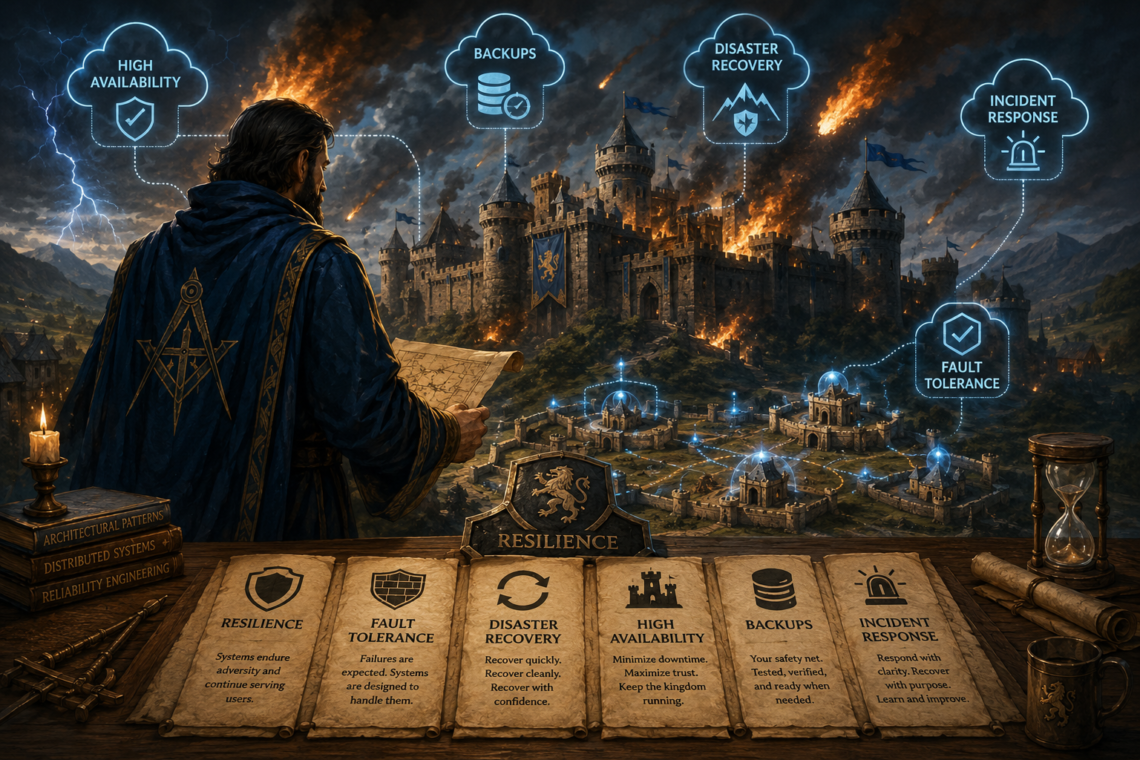
  • A fantasy-inspired digital illustration depicts a royal architect standing over maps and plans as a massive stone castle burns under a night sky filled with flaming projectiles. Although sections of the fortress are engulfed in flames, smaller fortified districts below remain connected by glowing blue pathways, symbolizing resilient system architecture and fault isolation. Floating holographic icons represent High Availability, Backups, Disaster Recovery, Fault Tolerance, and Incident Response, visually linking medieval defenses with modern software engineering concepts. Scrolls and architectural plans in the foreground reinforce themes of preparation, recovery, and thoughtful design, while the dramatic contrast between destruction and continuity emphasizes that resilient systems are designed to withstand failure rather than prevent it entirely.
    The Architect's Grimoire

    When the Kingdom Burns: Designing for Failure Before Disaster Strikes

    Hope is a poor evacuation plan. There is a quiet confidence that settles over every engineering team after enough successful deployments. Systems remain stable for months. Monitoring dashboards glow green. Customers continue using the software without incident, and the last major outage slowly fades into memory. Over time, it becomes easy to mistake reliability for a permanent characteristic of the software instead of recognizing it as the product of thousands of careful engineering decisions. That confidence is understandable, but it is also one of the greatest risks a software organization can face. Software rarely fails because developers expect it to fail. More often, it fails because teams gradually stop imagining…

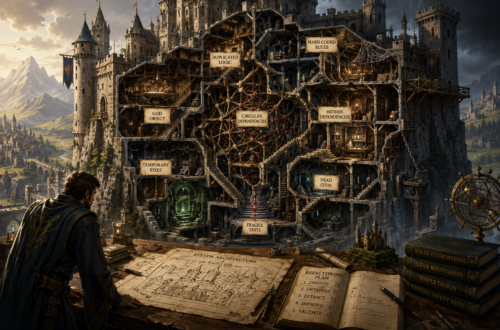
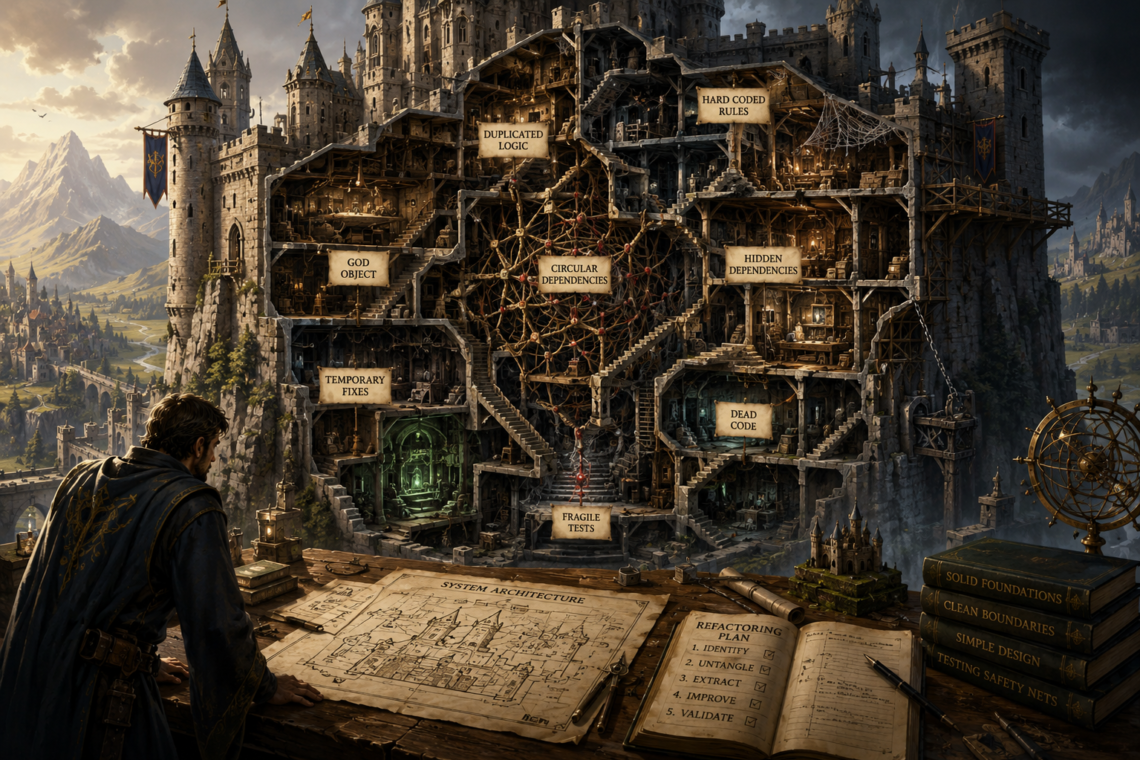
  • A detailed fantasy castle is shown in cross-section, revealing a maze of interconnected rooms, stairways, hidden passages, and structural layers that symbolize the complexity of a long-lived software system. At the center, tangled corridors and web-like connections represent circular dependencies and hidden coupling, while workshop-like chambers illustrate concepts such as duplicated logic, hard-coded rules, temporary fixes, fragile tests, dead code, and hidden dependencies. In the foreground, an architect studies blueprints and a refactoring plan spread across a drafting table, surrounded by engineering tools, manuscripts, and architectural diagrams. The surrounding kingdom is orderly and well maintained, contrasting with the increasingly convoluted interior of the castle. The painterly, Dungeons & Dragons-inspired editorial illustration uses fantasy architecture to represent technical debt, legacy systems, refactoring, and the challenge of maintaining software that has grown through years of incremental change.
    The Architect's Grimoire

    Hidden Traps in the Dungeon: Escaping Technical Debt

    The deadliest dangers are often the ones built into the castle itself. No architect intentionally designs a maze. Every castle begins with a sensible plan. Corridors connect naturally, storerooms serve nearby kitchens, towers overlook vulnerable approaches, and every staircase leads somewhere meaningful. Yet castles that survive for generations rarely retain that original simplicity. New rulers expand old wings. Temporary passageways become permanent corridors. Storage rooms become workshops. Secret tunnels built during one crisis remain long after the danger has passed. Over time, the castle becomes increasingly difficult to navigate, not because its builders lacked skill, but because each generation solved the problems immediately before them. Long-lived software follows the same…

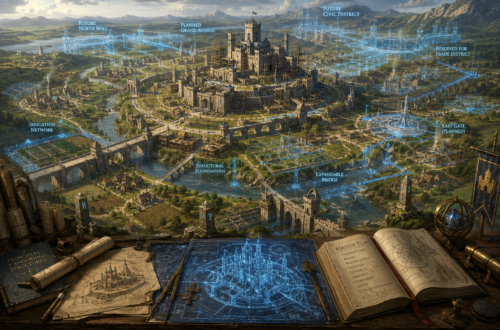
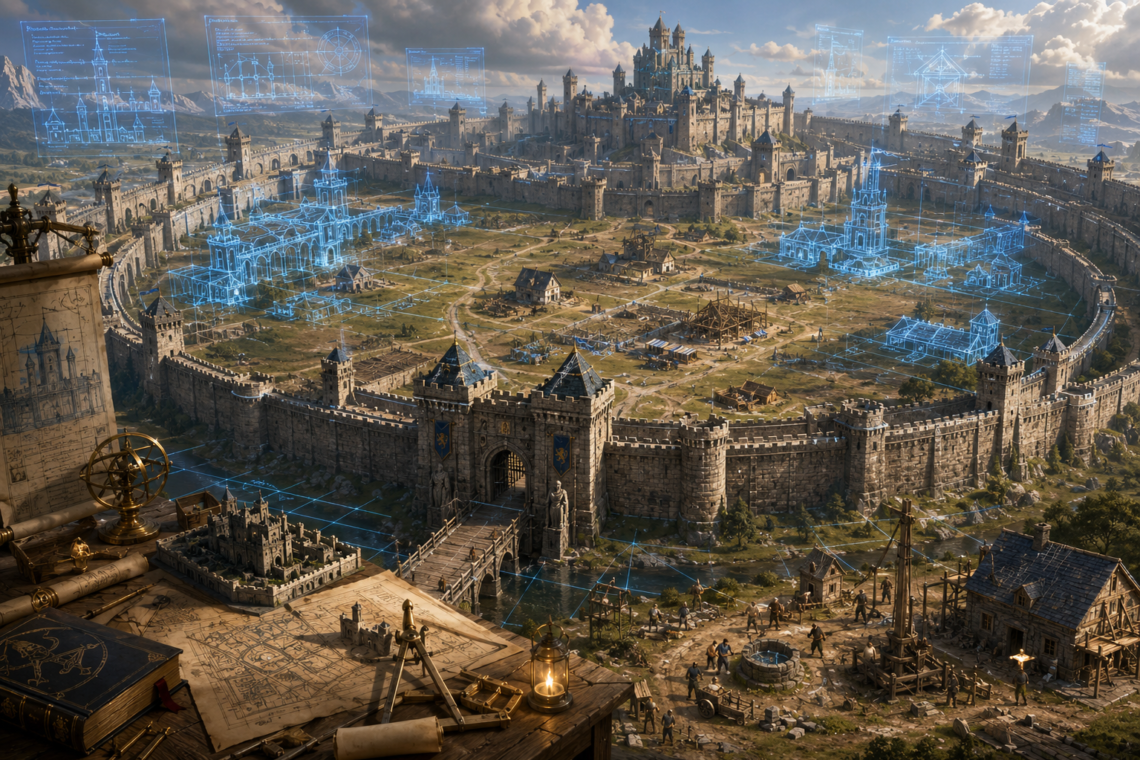
  • A vast medieval fantasy kingdom is enclosed within enormous concentric stone walls, towering gatehouses, fortified keeps, and defensive towers that dominate the landscape. Despite the immense fortifications, the protected interior remains largely undeveloped, with only a few cottages, a small farmhouse, scattered construction sites, unfinished roads, and a partially built marketplace spread across open fields. Glowing blue magical architectural projections overlay the empty city, revealing ambitious plans for future districts, guild halls, towers, canals, and public buildings that have yet to be constructed. In the foreground, drafting tables, blueprints, surveying instruments, and engineering tools reinforce the theme of excessive planning, while a small group of builders focuses on practical structures such as a well and simple homes. The painterly Dungeons & Dragons-inspired scene symbolizes the software engineering concept of premature overengineering by contrasting overwhelming defensive infrastructure with a kingdom that has barely begun to grow.
    The Architect's Grimoire

    The Curse of Premature Fortification

    Not every empty field needs a fortress. Software rarely becomes difficult to maintain because developers lacked technical ability. More often, intelligent engineers create long-term maintenance problems by solving challenges that have not yet appeared. A project begins with a handful of straightforward requirements, but its structure quickly expands to accommodate hypothetical integrations, future scalability, interchangeable components, and extension points that may never become necessary. Before long, the codebase grows steadily larger while the problem it exists to solve remains remarkably small. Long before the application reaches maturity, supporting the design requires nearly as much effort as advancing the product itself. Good design prepares software to evolve as knowledge grows. Premature…

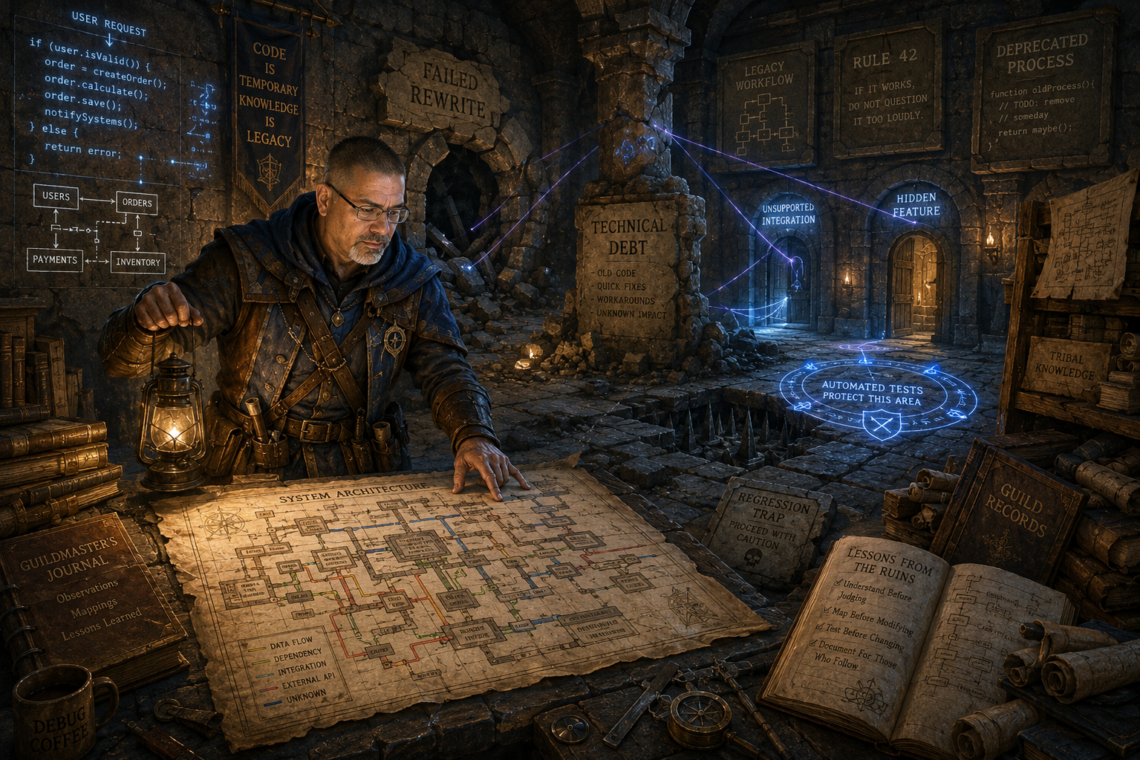
  • Frank Jamison, depicted as a seasoned Guildmaster and software engineer, studies a detailed architectural map inside a vast underground fantasy ruin representing a legacy software system. Wearing practical adventurer-scholar gear and holding a lantern, he stands at a stone table surrounded by guild journals, engineering records, maps, and ancient scrolls. Glowing blue runes resembling source code, database diagrams, and system architecture cover the dungeon walls. Nearby, a collapsed passage marked Failed Rewrite, a monument labeled Technical Debt, hidden doors representing undocumented features, and magical wards protecting explored areas symbolize the challenges of maintaining legacy code. The cinematic scene conveys exploration, problem-solving, knowledge preservation, and the careful navigation of complex software systems.
    The Guildmaster’s Handbook

    Legacy Code and Ancient Curses

    Every developer eventually enters forgotten ruins and wonders what kind of sorcery built them. Entering the Forgotten Ruins Among all the challenges software engineers face throughout their careers, few are as universal as inheriting legacy code. Most developers begin their journey imagining they will spend their days creating new applications, experimenting with modern technologies, and designing elegant architectures from a blank canvas. While those opportunities certainly exist, they represent only a portion of professional software development. Much of our work involves maintaining, extending, repairing, and modernizing systems that already exist. Some of these applications are only a few years old. Others have survived multiple generations of developers and business leaders.…


  • A grand medieval fantasy guild hall serves as a visual metaphor for JavaScript state management. At the center of the vast stone chamber, a glowing magical crystal labeled State powers a detailed miniature kingdom displayed on a large round table. Blue streams of magical energy connect the crystal to labeled regions representing inventory, quests, notifications, settings, world map, and UI components, illustrating how shared application state flows throughout an entire system. Massive banners surrounding the hall depict engineering concepts including actions, dispatch, reducers, state changes, subscribers, immutable updates, normalized structure, and a guild ledger that records every change. Ancient books, engineering diagrams, drafting tools, glowing runes, and architectural details reinforce themes of organization, maintainability, and long-term software design in a painterly, Dungeons & Dragons-inspired editorial illustration.
    The Full-Stack Campaign

    The Inventory System: Managing State Without Losing Control

    Editor’s Note This article is an updated and expanded edition of a lesson originally published on RandomThoughtsInTraffic.com. For this StackNScroll edition, I have substantially revised both the technical discussion and the engineering guidance to move beyond introducing JavaScript state and toward understanding the architectural decisions that allow interactive applications to grow without becoming fragile. New material explores immutable updates, centralized state transitions, shared application data, and engineering tradeoffs that emerge as software matures, all while reinforcing this week’s theme, The Spark of Adventure. My objective is not simply to explain state management, but to demonstrate why experienced engineers organize application state long before complexity demands it. The Spark of Adventure:…

  • A vast medieval royal armory stretches through a grand vaulted castle hall where hundreds of meticulously arranged suits of armor are displayed on pedestals, racks, and alcoves with perfect symmetry. Glowing golden magical construction lines, geometric drafting diagrams, measuring guides, and alignment grids overlay the architecture, emphasizing organization, hierarchy, and precision. Sunlight pours through towering stained-glass windows, illuminating polished steel armor, carved stone columns, architectural blueprints, measuring tools, and inventory ledgers. The richly detailed fantasy scene conveys craftsmanship, maintainability, and thoughtful design, symbolizing the principles of structured CSS layout and front-end architecture without depicting any people or action.
    The Full-Stack Campaign

    Armor and Appearance: CSS Layout Without Chaos

    Editor’s Note This article was originally published on RandomThoughtsInTraffic.com and has been extensively revised and expanded for its inclusion in StackNScroll. While the original introduced CSS layout through a fantasy-inspired perspective, this edition builds on those ideas with a deeper exploration of front-end architecture, examining the relationship among semantic HTML, Flexbox, Grid, responsive design, visual hierarchy, and maintainable styling systems. New material explores the engineering decisions that shape resilient layouts, emphasizing why experienced developers make particular architectural choices rather than simply demonstrating CSS techniques. The goal of this revised edition is to move beyond individual properties and help readers develop the mindset required to build interfaces that remain understandable, adaptable,…

  • Detailed fantasy cross-section illustration titled The Full-Stack Campaign: From Interface to Infrastructure. A sprawling medieval fantasy kingdom filled with castles, towers, bridges, marketplaces, and guild halls sits on the surface beneath a bright sky. The ground beneath the city is cut away to reveal multiple interconnected underground layers extending deep into the earth. Massive stone roads, elevators, tunnels, aqueducts, glowing magical conduits, and engineering works connect hidden chambers, archives, vaults, transit networks, and subterranean fortresses. The deepest levels contain enormous dwarven-style machinery, crystal power systems, and foundational infrastructure supporting the realm above. Informational panels label each layer of the kingdom, visually illustrating how visible systems depend upon increasingly complex hidden foundations. The image conveys themes of architecture, interconnected systems, dependencies, and the journey from user-facing experiences to the infrastructure that supports them.
    The Full-Stack Campaign

    From Interface to Infrastructure

    Before adventurers can explore the world, they must understand the rules that shape it. Editor’s Note Before appearing as the opening chapter of The Full-Stack Campaign: From Interface to Infrastructure, this article first appeared on RandomThoughtsInTraffic.com as an exploration of why developers often struggle when their knowledge remains confined to a single layer of the technology stack. This revised and expanded edition examines how information travels through modern web applications, explores the relationships between browsers, APIs, servers, databases, and infrastructure, and establishes the systems-oriented mindset that guides the remainder of the series. New material includes expanded architectural examples, a deeper discussion of specialization within software development, and a practical examination…

  • A massive ancient spellbook rests open on an ornate stone lectern at the center of a grand wizard's archive. The book's pages are filled with intricate geometric diagrams, arcane constructions, layered annotations, and evidence of repeated revisions, including crossed-out symbols and inserted bookmarks. Floating above the spellbook is a complex network of glowing blue and gold magical sigils connected by delicate lines and circular structures, appearing increasingly organized toward the center. Surrounding the lectern are stacks of weathered grimoires, loose parchment diagrams, quills, measuring instruments, compasses, and scholarly tools scattered across a richly detailed workspace. Warm lantern light illuminates the archive while magical energy radiates upward from the book, creating an atmosphere of careful refinement, accumulated knowledge, and the ongoing maintenance of a powerful arcane reference.
    The CSS Codex

    Refactoring the Spellbook

    Every spellbook gathers clutter until a wizard dares to rewrite it. Editor’s Note: This article is an expanded and revised edition of a piece originally published on RandomThoughtsInTraffic.com. While the original article focused primarily on the practical need to clean up aging stylesheets, this StackNScroll edition explores refactoring as a long-term architectural discipline within CSS systems. New material examines design tokens, specificity management, component ownership, incremental refactoring strategies, dead code removal, and the relationship between technical debt and maintainability during long-lived projects. As part of this week’s theme, The Long Campaign, the article focuses on how experienced developers preserve the health of stylesheets over months and years of continuous development,…

  • A grand fantasy chamber deep beneath an ancient royal castle, centered on a massive illuminated stone contract resting atop a circular dais. Golden streams of magical energy radiate from the contract to hundreds of surrounding scrolls, tablets, seals, and carved monuments arranged throughout the vast hall. Above the dais, an intricate network of glowing geometric symbols, circles, and interconnected pathways forms a luminous hierarchy suspended in the air, suggesting authority, inheritance, and shared laws. Towering stone pillars covered in ornate carvings frame the scene, while warm golden light fills the chamber with an atmosphere of governance, order, institutional knowledge, and enduring stewardship. The composition emphasizes a single binding agreement serving as the foundation for an entire realm.
    The CSS Codex

    Variables as Binding Contracts

    Strong kingdoms endure because their laws are written, not remembered. Editor’s Note: This article was originally published on RandomThoughtsInTraffic.com and has been revised and expanded for StackNScroll as part of The CSS Codex series. The original edition introduced CSS variables primarily as a practical mechanism for reducing duplication within stylesheets. This revised version expands that discussion considerably, examining variables as architectural agreements that govern design systems, component behavior, and long-term maintainability. New material explores naming conventions, design token strategies, component contracts, variable inheritance, theming, and how experienced engineers use variables to build systems that remain understandable years after their original implementation. As part of this week’s theme, The Long Campaign,…